How Does AI Like ChatGPT Work? Language Models Explained Simply
Chatbots like ChatGPT write by predicting the next piece of text. How language models are trained, why they sometimes make things up and how to use them well.
Short answer
AI chatbots such as ChatGPT are built on large language models: huge neural networks trained on enormous amounts of text to predict what comes next. The text is broken into small pieces called tokens, and for each step the model calculates how likely every possible next token is, picks one, adds it to the text and repeats. Most modern models use the ‘transformer’ design introduced in 2017, which lets them weigh how every word relates to every other word. After this pre-training, they are fine-tuned on examples written by people and adjusted with human feedback so that they follow instructions and give helpful answers. Because they generate plausible text rather than looking facts up, they can sometimes state wrong information confidently.
In this article (8)
Ask a chatbot to explain black holes, draft an email or write a poem about your cat, and within seconds it produces fluent, often impressive text. Tools such as ChatGPT, Gemini and Claude have become part of daily life for hundreds of millions of people since late 2022. But what is actually happening inside? Is the computer thinking, searching a giant database or doing something else entirely? The answer is both simpler and stranger than most people expect.
The core idea: predict the next piece
At its heart, a chatbot is powered by a large language model (LLM). Its basic job sounds almost too simple: given some text, predict what comes next.
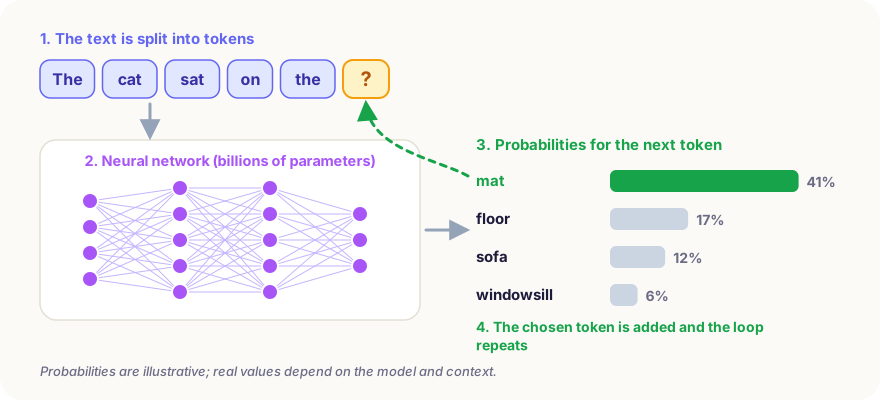
- Your text is split into small pieces called tokens. A token can be a short word, part of a longer word or a punctuation mark.
- The model, a huge neural network, processes all the tokens so far.
- It calculates a probability for every possible next token. After “The cat sat on the”, words like “mat” or “floor” get high probabilities; “volcano” gets a very low one.
- One token is chosen, usually one of the most likely, with a little randomness to keep the text natural.
- That token is added to the text, and the whole process repeats, token after token, until the answer is complete.
That is why chatbot answers appear gradually on screen: they are being generated one piece at a time.
Neural networks and parameters
A neural network is a mathematical structure loosely inspired by the brain. It consists of layers of simple units connected by parameters, numbers that determine how strongly each signal influences the next. Large language models have billions of parameters.
At the start of training, these numbers are random and the model’s predictions are nonsense. Training gradually adjusts them so that the predictions get better. No one programs in grammar rules or facts directly; the model picks up patterns about language and the world from the data.
The transformer: paying attention
Most modern language models use a design called the transformer, introduced by researchers at Google in a 2017 paper with the memorable title Attention Is All You Need. Its key ingredient is a mechanism called attention, which lets the model weigh how relevant each token is to every other token.
Take the sentence “The trophy did not fit in the suitcase because it was too big.” To predict well, the model needs to work out that “it” refers to the trophy. Attention allows it to connect words that are far apart and build up context. Transformers can also process many tokens in parallel, which made it practical to train them on vast amounts of text using powerful computer chips.
How a chatbot is trained
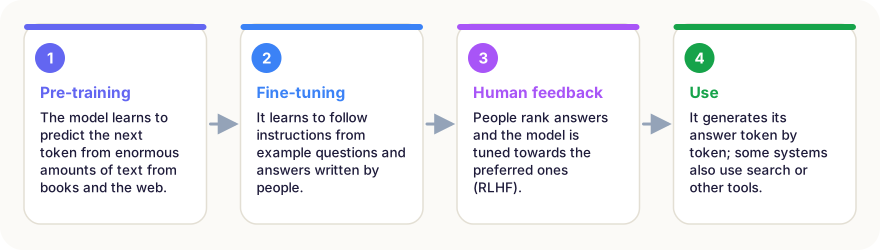
Building a chatbot usually involves several stages:
| Stage | What happens | Result |
|---|---|---|
| Pre-training | The model learns to predict the next token on enormous amounts of text from books, websites and other sources | Broad knowledge of language and the world |
| Fine-tuning | It is trained on examples of questions and good answers written by people | Follows instructions and answers in a conversational style |
| Human feedback (RLHF) | People compare and rank answers; the model is adjusted towards the preferred ones | More helpful, honest and safer responses |
| Use | It generates answers token by token, sometimes with tools such as search | The chatbot you talk to |
A 2022 paper by Long Ouyang and colleagues at OpenAI described how this reinforcement learning from human feedback (RLHF) made a model far better at following instructions. In their tests, people preferred answers from a much smaller model trained this way over those of a far larger model without it.
What chatbots are good at
Language models are very good at tasks built on patterns in language:
- explaining concepts in simple words,
- summarising and translating text,
- drafting and editing emails, essays and code,
- brainstorming ideas and answering follow-up questions.
They can also work through many reasoning problems step by step, especially newer models trained to “think” before answering.
Their limits
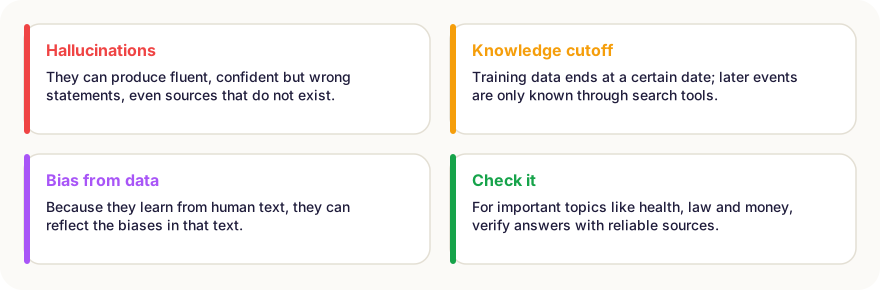
Because a language model generates plausible text rather than looking facts up, it has some important weaknesses:
- Hallucinations: it can produce confident, fluent statements that are simply wrong, including quotes or sources that do not exist.
- Knowledge cutoff: its training data ends at a certain date. Without a search tool, it does not know about later events.
- Bias: because it learns from human writing, it can reflect biases in that writing, although developers try to reduce this.
- No built-in fact-checking: it does not automatically verify what it says against reliable sources.
For important topics such as health, law, money or safety, treat chatbot answers as a starting point and check them against trustworthy sources or professionals.
Is it really intelligent?
Whether language models “understand” language is one of the liveliest debates in science and philosophy. They clearly capture a great deal of knowledge and can solve problems they were never explicitly shown. At the same time, they work very differently from human minds: they learn from text rather than living in the world, and they can fail in ways no human would. Most researchers agree on one thing: these systems are powerful tools whose abilities and limits are still being mapped.
In short
- Chatbots run on large language models trained to predict the next token.
- Text is split into tokens; the model picks one at a time and repeats.
- Most models use the transformer design from 2017, built around attention.
- Training includes pre-training, fine-tuning and human feedback (RLHF).
- They can hallucinate, have a knowledge cutoff and may reflect biases.
- Use them as helpful assistants, but check important answers.
Frequently asked questions
Does ChatGPT search the internet?
A language model on its own does not; it answers from patterns learned during training. Some chatbot products add a separate search tool that fetches web pages and passes them to the model, and they usually say when they have done so.
Why do AI chatbots make mistakes?
They are trained to produce likely-sounding text, not to check facts. When the training data is thin, contradictory or outdated, they may ‘hallucinate’: give fluent but wrong answers, sometimes with invented sources.
Does AI understand what it says?
This is debated. Language models capture a great deal about language and the world and can reason through many problems, but they work very differently from human brains, and researchers disagree about how to describe their ‘understanding’.
What is a token?
A token is a small chunk of text, often a whole short word, part of a longer word or a punctuation mark. Language models read and write in tokens, and their limits are often measured in tokens.
Sources
- Vaswani et al. (2017) – Attention Is All You Need, arXiv
- Ouyang et al. (2022) – Training language models to follow instructions with human feedback, arXiv
This article is based on peer-reviewed research and publications from trusted institutions, and it is reviewed regularly. How we work →
You might also wonder
All in How Things Work →
How Do Electric Cars Work? Batteries, Motors, Charging and Range Explained
Electric cars have no fuel tank or gearbox. How the battery, inverter and motor work, why EVs are so efficient and how charging and range work.
How Does the Internet Work? Packets, Cables and the Journey of a Web Page
Opening a website sends data across cables, routers and oceans in milliseconds. How DNS, IP, TCP and undersea cables bring a web page to your screen.

How Do Aeroplanes Fly? Lift, Wings and a Famous Myth
A jumbo jet weighs hundreds of tonnes, yet stays in the air. How wings create lift, the four forces of flight, and why a popular explanation is wrong.
How Do Touchscreens Work? Why Your Finger Works and Gloves Don’t
Phone screens sense your finger through an invisible electrical grid. How capacitive and resistive touchscreens work, how multi-touch works and why gloves fail.
How Does GPS Work? Satellites, Atomic Clocks and Einstein
Your phone finds its position from satellites 20,000 km away. How GPS uses signal timing, why it needs four satellites and why Einstein’s relativity matters.
How Do QR Codes Work? The Squares That Store Links and Text
A QR code stores data as a grid of black and white squares. What the corner squares do, how damaged codes still work and where QR codes came from.