How Do Electric Cars Work? Batteries, Motors, Charging and Range Explained
Electric cars have no fuel tank or gearbox. How the battery, inverter and motor work, why EVs are so efficient and how charging and range work.
Short answer
An electric car stores energy in a large lithium-ion battery, usually built into the floor. When you press the accelerator, an inverter converts the battery’s direct current into alternating current, which drives an electric motor. The motor uses magnetic fields to turn the wheels, delivering full force almost instantly and needing no multi-speed gearbox. When you slow down, the motor works in reverse as a generator, turning motion back into electricity in a process called regenerative braking. According to the US Department of Energy, electric cars convert over 77% of the electricity from the grid into motion, compared with about 12–30% for petrol cars, which lose most of their energy as heat.
In this article (7)
Open the bonnet of a petrol car and you will find a tangle of pistons, valves, belts, exhaust pipes and a gearbox. Open the front of many electric cars and you might find… a storage compartment. Electric cars move in a completely different way, with far fewer parts. They are also no longer a niche: according to the International Energy Agency, more than 17 million electric cars were sold worldwide in 2024, over a fifth of all new cars.
The main parts
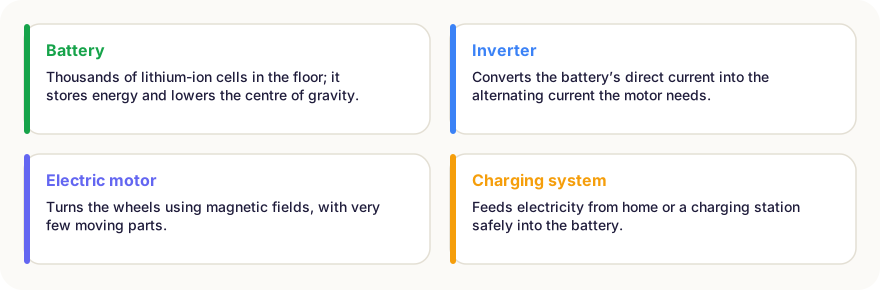
According to the US Department of Energy, a battery electric car is built around a few key components:
| Part | What it does | Petrol car equivalent |
|---|---|---|
| Traction battery | Stores electrical energy, usually in the floor | Fuel tank |
| Inverter / power electronics | Converts DC from the battery into AC for the motor and controls power | Fuel injection and engine control |
| Electric motor | Turns the wheels using magnetic fields | Engine |
| On-board charger and charge port | Takes electricity from the grid and charges the battery | Fuel filler |
| Single-speed transmission | Reduces motor speed to wheel speed | Multi-speed gearbox |
The battery
The heart of an electric car is a large lithium-ion battery, similar in chemistry to the one in your phone but made of hundreds or thousands of cells working together. Its capacity is measured in kilowatt-hours (kWh); typical cars have batteries of about 40 to 100 kWh. Because the battery is heavy and sits low in the floor, it lowers the car’s centre of gravity, which helps with stability.
A battery management system constantly watches each cell’s temperature and charge, and many cars use liquid cooling to keep the battery in its comfortable range.
The inverter and motor
The battery provides direct current (DC), but most electric car motors run on alternating current (AC). The inverter converts one into the other and, by changing the frequency, controls how fast the motor turns. Pressing the accelerator simply tells the inverter to send more power.
The electric motor has a stationary part, the stator, and a rotating part, the rotor. Electric currents create a rotating magnetic field in the stator that drags the rotor around. With very few moving parts, there is no oil to change, no spark plugs and no exhaust.
Why electric cars feel so quick
A combustion engine has to rev up before it delivers its best power. An electric motor produces strong torque from a standstill. That is why even ordinary family electric cars often accelerate briskly from traffic lights, and why they need only a single gear: the motor works efficiently across a very wide speed range.
Efficiency: where the energy goes

The biggest difference is efficiency. According to the US Department of Energy’s fuel economy site, electric cars convert over 77% of the electrical energy from the grid into power at the wheels, while conventional petrol cars convert only about 12–30% of the energy in their fuel. Most of a petrol engine’s energy escapes as heat through the radiator and exhaust.
Electric cars also recover energy through regenerative braking. When you lift off the accelerator or brake, the motor acts as a generator, slowing the car while sending electricity back to the battery. In city traffic, with frequent stopping, this makes a noticeable difference; many drivers can do most of their braking without touching the brake pedal.
Charging: plugs, power and the 80% rule
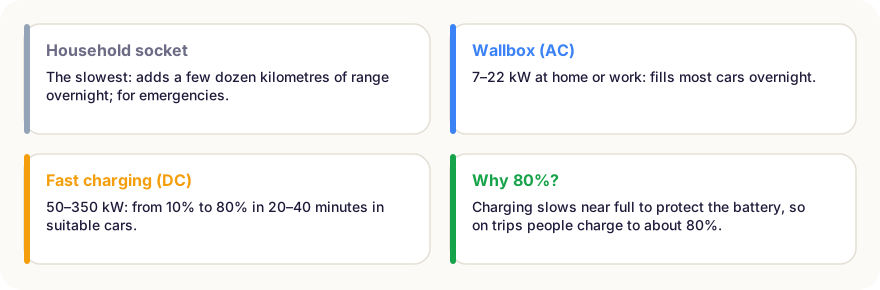
There are two main ways to charge:
- AC charging, from a household socket or a wallbox, goes through the car’s on-board charger. It is slower but gentle, and fits overnight charging at home.
- DC fast charging bypasses the on-board charger and feeds high power directly into the battery. On a road trip, a stop of 20 to 40 minutes can add several hundred kilometres of range in a suitable car.
Charging speed is not constant. It is fastest when the battery is fairly empty and slows down as it fills, to protect the cells. That is why on long journeys drivers often charge only to around 80% and move on.
Range and what affects it
An electric car’s range, how far it can go on a full charge, depends on battery size and efficiency. Many modern cars manage 300 to 500 kilometres in ideal conditions. Range drops with:
- high motorway speeds, because air resistance grows sharply with speed,
- cold weather, which slows battery chemistry and requires energy for heating,
- heavy loads, roof boxes and aggressive driving.
Heat pumps, which heat the cabin more efficiently, and preheating the car while it is still plugged in help reduce winter losses.
Not a new idea
Electric cars are older than most people think. Inventors built electric vehicles in the 19th century, and around 1900, electric cars were common in American cities, prized for being quiet and clean. Cheap petrol, mass production and the electric starter motor then made combustion cars dominant for a century. Better batteries, especially lithium-ion cells, brought electric cars back in the 21st century.
In short
- An electric car stores energy in a lithium-ion battery, usually in the floor.
- An inverter turns the battery’s DC into AC to drive the electric motor.
- Electric motors give strong torque from zero and need only one gear.
- EVs turn over 77% of grid energy into motion, petrol cars about 12–30%.
- Regenerative braking turns motion back into electricity.
- Fast chargers reach about 80% in 20 to 40 minutes; cold and high speed reduce range.
Frequently asked questions
How long does it take to charge an electric car?
It depends on the charger. A home wallbox (7–22 kW) usually fills a car overnight. A DC fast charger (50–350 kW) can take a suitable car from about 10% to 80% in roughly 20 to 40 minutes.
How long does an electric car battery last?
Modern batteries are designed to last many years and typically keep most of their capacity for well over 100,000 kilometres. Manufacturers commonly offer battery warranties of around eight years.
Why does range drop in winter?
Cold slows the chemical reactions in the battery, and heating the cabin uses energy that petrol cars get for free from engine waste heat. Heat pumps and preheating while plugged in reduce the loss.
Do electric cars have gearboxes?
Most have only a single-speed reduction gear. Electric motors produce strong torque from zero and can spin very fast, so they do not need multiple gears like a combustion engine.
Sources
- US Department of Energy, Alternative Fuels Data Center – How Do All-Electric Cars Work?
- US Department of Energy / EPA – All-Electric Vehicles (fueleconomy.gov)
- International Energy Agency – Global EV Outlook 2025
This article is based on peer-reviewed research and publications from trusted institutions, and it is reviewed regularly. How we work →
You might also wonder
All in How Things Work →
How Does the Internet Work? Packets, Cables and the Journey of a Web Page
Opening a website sends data across cables, routers and oceans in milliseconds. How DNS, IP, TCP and undersea cables bring a web page to your screen.

How Do Aeroplanes Fly? Lift, Wings and a Famous Myth
A jumbo jet weighs hundreds of tonnes, yet stays in the air. How wings create lift, the four forces of flight, and why a popular explanation is wrong.

How Do Touchscreens Work? Why Your Finger Works and Gloves Don’t
Phone screens sense your finger through an invisible electrical grid. How capacitive and resistive touchscreens work, how multi-touch works and why gloves fail.

How Does GPS Work? Satellites, Atomic Clocks and Einstein
Your phone finds its position from satellites 20,000 km away. How GPS uses signal timing, why it needs four satellites and why Einstein’s relativity matters.

How Do QR Codes Work? The Squares That Store Links and Text
A QR code stores data as a grid of black and white squares. What the corner squares do, how damaged codes still work and where QR codes came from.
How Do Solar Panels Work? Turning Sunlight Into Electricity
Solar panels use the photovoltaic effect: light frees electrons in silicon, and an electric field turns them into a current. How efficient are they?