How Do Solar Panels Work? Turning Sunlight Into Electricity
Solar panels use the photovoltaic effect: light frees electrons in silicon, and an electric field turns them into a current. How efficient are they?
Short answer
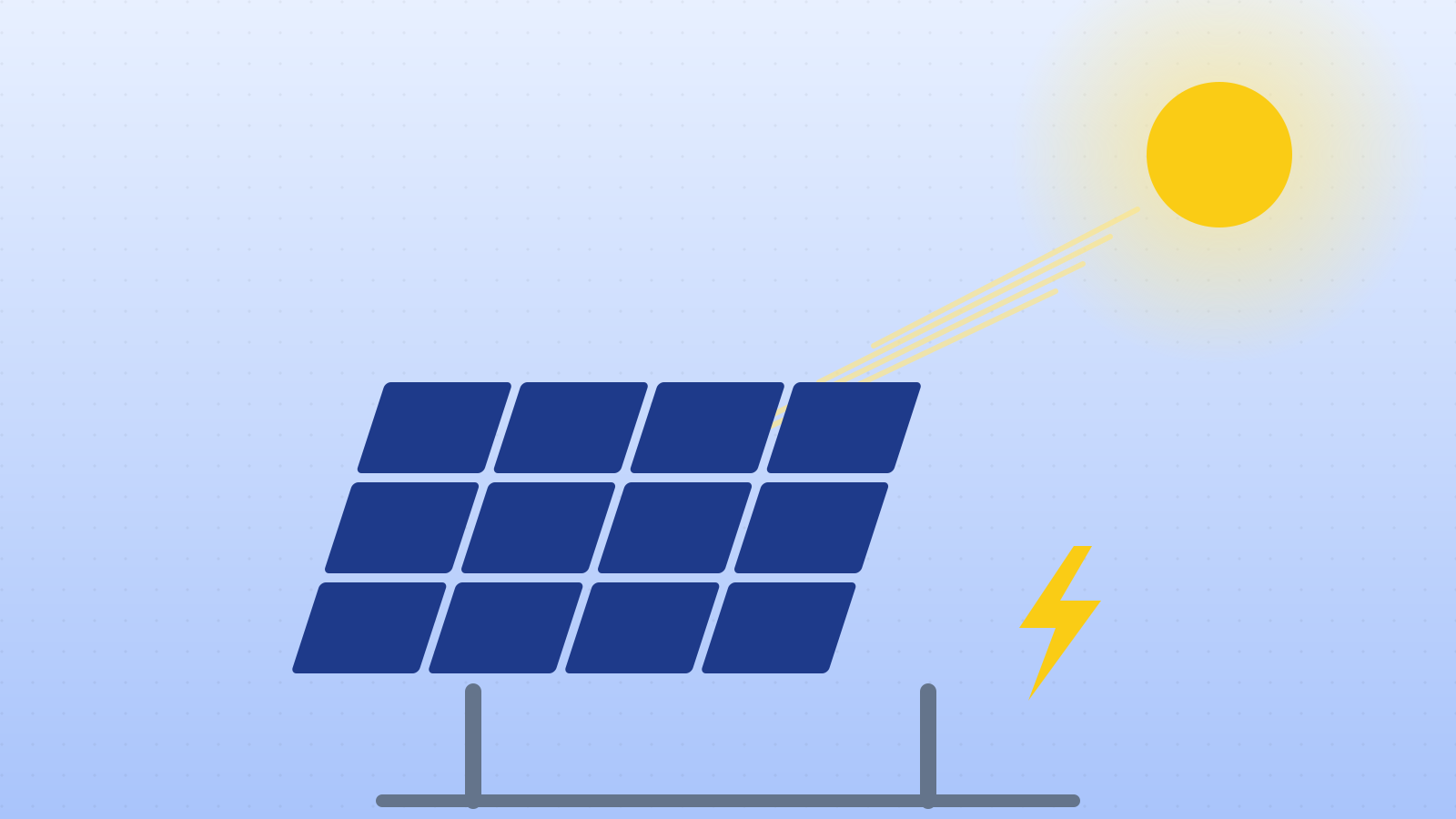
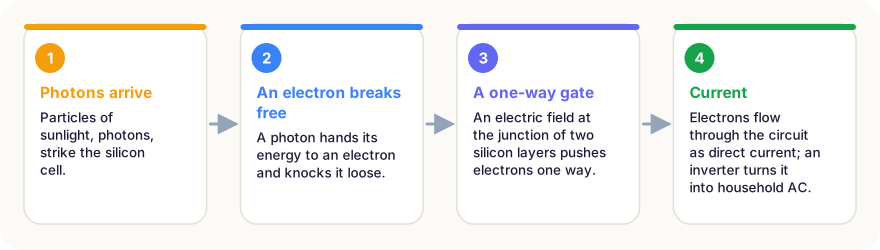
Solar panels turn sunlight directly into electricity using the photovoltaic effect. Each panel is made of many solar cells, usually thin wafers of silicon. Each cell has two layers of silicon treated with different elements, creating an electric field at the boundary between them. When particles of light, called photons, hit the cell, they give their energy to electrons and knock them loose. The electric field pushes these freed electrons in one direction, so they flow through wires as an electric current. This direct current is converted by an inverter into the alternating current used in homes. Typical rooftop panels convert about 20 to 23% of sunlight into electricity.
In this article (6)
On rooftops, in fields and even on calculators, dark blue and black panels quietly turn sunlight into electricity, with no moving parts, no noise and no fuel. Solar power is now one of the cheapest sources of electricity in history. But how can a flat sheet of glass and silicon make electricity from light?
The photovoltaic effect
Light is made of tiny packets of energy called photons. When a photon hits certain materials, it can transfer its energy to an electron and knock it free from its atom. If those freed electrons can be pushed to flow in one direction, you have an electric current. This is the photovoltaic effect, “photo” meaning light and “voltaic” meaning electricity.
Inside a solar cell
Most solar cells are made of silicon, the same element used in computer chips and found in sand. A cell is a thin wafer with two layers:
- The top layer is treated, or “doped”, with a small amount of an element such as phosphorus, which gives it extra electrons. This is the n-type layer.
- The bottom layer is doped with an element such as boron, which leaves gaps, called holes, where electrons are missing. This is the p-type layer.
Where the two layers meet, the p-n junction, electrons and holes rearrange themselves and create a built-in electric field. It acts like a one-way gate.
When sunlight knocks electrons loose, this field sweeps them towards the top of the cell and holes towards the bottom. Thin metal lines on the surface collect the electrons, which then flow through an external circuit, powering a lamp or charging a battery, before returning to the bottom of the cell. As long as light shines, the flow continues.
From panel to plug
A single cell produces only about half a volt. A panel connects dozens of cells to produce a useful voltage. Panels produce direct current (DC), while homes use alternating current (AC), so an inverter converts it. Extra electricity can charge batteries or be fed into the power grid.
How efficient are solar panels?
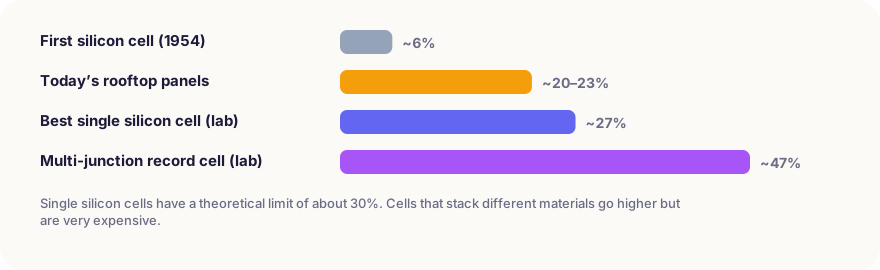
Not every photon produces electricity. Some light is reflected, some photons have too little energy to free an electron, and photons with too much energy waste the excess as heat. Typical rooftop panels today convert about 20 to 23% of sunlight into electricity. The best single silicon cells in the laboratory reach about 27%, close to silicon’s theoretical limit of about 30%.
To go higher, researchers stack layers of different materials, each tuned to a different part of the spectrum. Such multi-junction cells have passed 47% in the laboratory, but they are expensive and used mainly in spacecraft and special systems. Newer materials called perovskites are being combined with silicon to raise efficiency at lower cost.
Light, not heat
Solar panels need light, not warmth. In fact, they become slightly less efficient as they heat up, so a cold, bright spring day can be better than a scorching summer afternoon. They still produce some electricity on cloudy days, but none at night.
In short
- Solar panels use the photovoltaic effect: light knocks electrons loose.
- Cells are made of two layers of silicon that create a built-in electric field.
- The field pushes electrons one way, producing direct current.
- An inverter converts it into the alternating current used at home.
- Rooftop panels convert about 20–23% of sunlight; lab cells have passed 47%.
- Panels need light, not heat, and work best on cool, sunny days.
Frequently asked questions
Do solar panels work on cloudy days?
Yes, but less well. Panels still produce electricity from diffuse daylight on cloudy days, typically a fraction of their output in full sun. They produce nothing at night.
How long do solar panels last?
Most panels come with warranties of 25 years or more and slowly lose efficiency, often around half a percent per year. Many continue working well beyond their warranty.
Do solar panels work better when it is hot?
No. Panels need light, not heat, and their efficiency actually drops slightly as they get hotter. Cool, sunny days are ideal.
What happens to the electricity at night?
Homes with solar panels usually draw power from the grid at night, or use batteries charged during the day. Excess daytime electricity can often be fed into the grid.
Sources
This article is based on peer-reviewed research and publications from trusted institutions, and it is reviewed regularly. How we work →
You might also wonder
All in How Things Work →
How Do Aeroplanes Fly? Lift, Wings and a Famous Myth
A jumbo jet weighs hundreds of tonnes, yet stays in the air. How wings create lift, the four forces of flight, and why a popular explanation is wrong.

How Do Touchscreens Work? Why Your Finger Works and Gloves Don’t
Phone screens sense your finger through an invisible electrical grid. How capacitive and resistive touchscreens work, how multi-touch works and why gloves fail.
How Does GPS Work? Satellites, Atomic Clocks and Einstein
Your phone finds its position from satellites 20,000 km away. How GPS uses signal timing, why it needs four satellites and why Einstein’s relativity matters.

How Do QR Codes Work? The Squares That Store Links and Text
A QR code stores data as a grid of black and white squares. What the corner squares do, how damaged codes still work and where QR codes came from.
How Does Noise Cancelling Work? Fighting Sound With Anti-Sound
Noise-cancelling headphones record outside noise and play its exact opposite, so the two waves cancel out. Why it silences engine hum but not voices.
How Do Rechargeable Batteries Work? Inside a Lithium-Ion Battery
Your phone’s battery moves lithium ions back and forth between two layers. How charging works, why batteries wear out and the habits that make them last longer.