How Does Noise Cancelling Work? Fighting Sound With Anti-Sound
Noise-cancelling headphones record outside noise and play its exact opposite, so the two waves cancel out. Why it silences engine hum but not voices.
Short answer
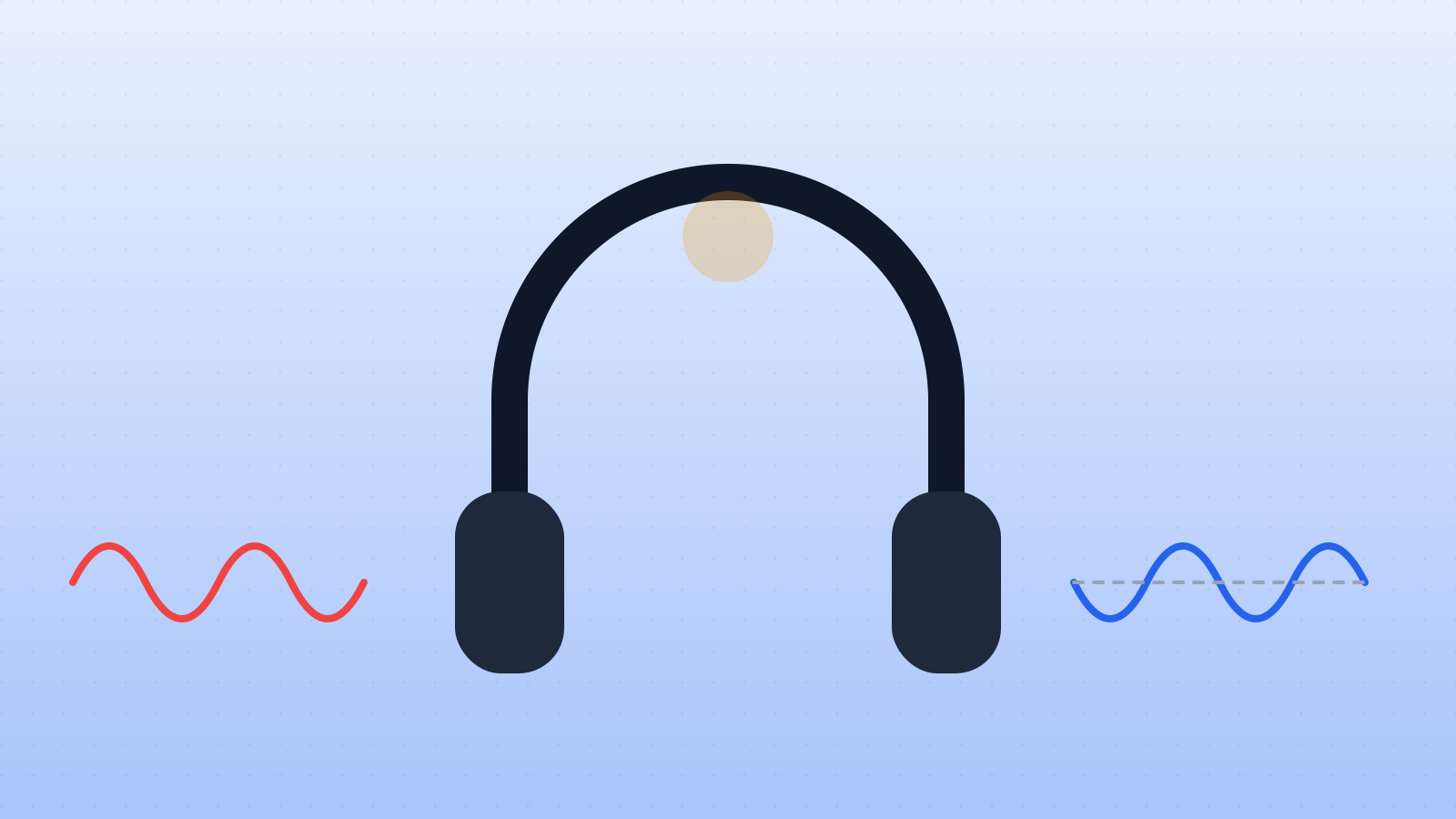
Active noise-cancelling headphones fight sound with sound. Small microphones on the earcups or earbuds continuously pick up the noise around you. A processor analyses this sound and creates an “anti-noise” wave that is its mirror image: where the noise wave has a peak, the anti-noise has a trough. The speaker plays this inverted wave along with your music. When the two waves meet in your ear, they cancel each other out through destructive interference, so much of the noise disappears. The technique works best on low, steady sounds such as aircraft engines and train rumble; sudden, high-pitched sounds are harder to cancel and are mainly blocked by the earcups and tips.
In this article (5)
Put on a pair of noise-cancelling headphones in a plane or train, switch them on, and the roar of the engine seems to fade away as if someone had turned down the world. Nothing physically blocks the sound more than before. Instead, the headphones are making their own sound, designed to destroy the noise.
Sound is a wave
Sound travels through the air as a pressure wave: tiny regions where air is squeezed together, called compressions, alternate with regions where it is spread out, called rarefactions. On a graph, this looks like a wave with peaks and troughs.
When two sound waves meet, they add together. If their peaks line up, the sound gets louder. But if the peak of one meets the trough of the other, they cancel out. This is called destructive interference, and it is the secret behind noise cancelling.
Making anti-noise
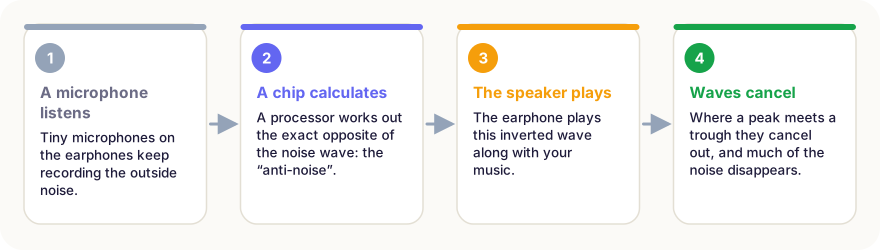
Active noise-cancelling headphones contain:
- Microphones that constantly pick up the sound around you. Many headphones use one microphone outside the earcup to hear incoming noise and one inside to check what actually reaches your ear.
- A fast processor that analyses the noise and calculates the exact opposite wave, the anti-noise.
- The speaker, which plays the anti-noise mixed with your music or call.
When the noise and the anti-noise meet at your ear, they largely cancel each other out. The system must work very fast: if the anti-noise arrives even slightly too late, it no longer lines up with the noise and the cancellation fails.
What it can and cannot silence
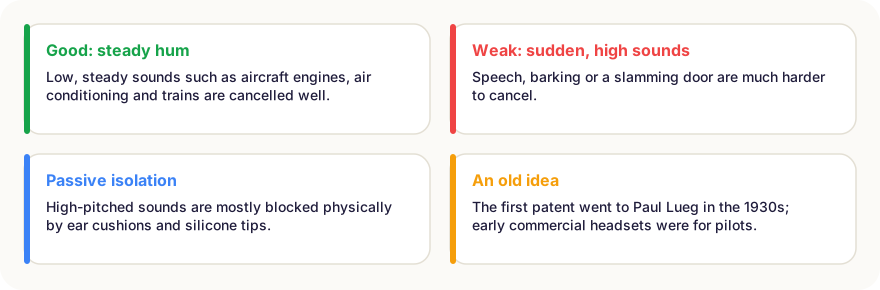
Active cancelling works best on low-frequency, steady sounds, below about 1,000 hertz: the drone of jet engines, the rumble of trains, the hum of air conditioning. These sounds are predictable and have long wavelengths, so it is easy to stay in step with them.
It is much less effective on sudden or high-pitched sounds, such as voices, barking dogs or a door slamming. These change too quickly to predict and cancel accurately. That is why you can often still hear someone talking nearby.
Here, passive isolation takes over. Earcups, foam cushions and silicone tips physically block high-frequency sound, which is easier to stop with materials. The best headphones combine both.
A 90-year-old idea
The principle is old. In the 1930s, German physicist Paul Lueg patented the idea of cancelling sound with an opposite wave from a loudspeaker. But the electronics of the time were too slow. Practical systems arrived only decades later: the first commercial noise-cancelling headsets were made for pilots in the late 1980s, to protect their hearing and make radio communication clearer. Consumer headphones followed, and today noise cancelling fits into tiny wireless earbuds.
Similar technology is used in some cars to cancel road and engine noise inside the cabin, and in industrial settings to reduce the noise of ducts and fans.
In short
- Noise-cancelling headphones use microphones to record outside noise.
- A processor creates an anti-noise wave that is the noise’s mirror image.
- When the waves meet, they cancel by destructive interference.
- It works best on low, steady sounds like engines and trains.
- Voices and sudden sounds are harder to cancel; passive isolation helps there.
- The idea was patented by Paul Lueg in the 1930s; the first commercial headsets were for pilots.
Frequently asked questions
Is noise cancelling bad for your ears?
No. It can actually protect hearing, because people tend to listen at lower volumes when background noise is reduced. Some people feel a slight pressure sensation, which is harmless.
What is the difference between active and passive noise cancelling?
Passive noise isolation physically blocks sound with seals, cushions and ear tips. Active noise cancelling uses microphones and electronics to create anti-noise. Good headphones combine both.
What is transparency mode?
Transparency or ambient mode does the opposite: it uses the microphones to pass outside sound through to your ears, so you can hear announcements or traffic without removing your headphones.
Why can I still hear people talking?
Speech is made of rapidly changing, higher frequencies that are hard to predict and cancel in time. Active cancelling is most effective below about 1,000 hertz, where engine noise lives.
Sources
- Kuo, S. M. & Morgan, D. R. (1999). Active noise control: a tutorial review. Proceedings of the IEEE
- Encyclopaedia Britannica – Sound
This article is based on peer-reviewed research and publications from trusted institutions, and it is reviewed regularly. How we work →
You might also wonder
All in How Things Work →
How Do Aeroplanes Fly? Lift, Wings and a Famous Myth
A jumbo jet weighs hundreds of tonnes, yet stays in the air. How wings create lift, the four forces of flight, and why a popular explanation is wrong.

How Do Touchscreens Work? Why Your Finger Works and Gloves Don’t
Phone screens sense your finger through an invisible electrical grid. How capacitive and resistive touchscreens work, how multi-touch works and why gloves fail.

How Does GPS Work? Satellites, Atomic Clocks and Einstein
Your phone finds its position from satellites 20,000 km away. How GPS uses signal timing, why it needs four satellites and why Einstein’s relativity matters.

How Do QR Codes Work? The Squares That Store Links and Text
A QR code stores data as a grid of black and white squares. What the corner squares do, how damaged codes still work and where QR codes came from.
How Do Solar Panels Work? Turning Sunlight Into Electricity
Solar panels use the photovoltaic effect: light frees electrons in silicon, and an electric field turns them into a current. How efficient are they?
How Do Rechargeable Batteries Work? Inside a Lithium-Ion Battery
Your phone’s battery moves lithium ions back and forth between two layers. How charging works, why batteries wear out and the habits that make them last longer.