How Do Hurricanes Form? From Warm Ocean to Monster Storm
Hurricanes are giant storms powered by warm ocean water. How they form, why they spin, what the categories mean and how climate change affects them.

Short answer
Hurricanes form over warm tropical oceans, where the sea surface is at least about 26.5 °C. Warm water evaporates, and as the moist air rises it cools and condenses into clouds, releasing heat that makes the air rise even faster and lowers the pressure at the surface. More air rushes in to replace it, and Earth’s rotation, through the Coriolis effect, makes this inflowing air spiral around the centre. If conditions stay favourable, the storm organises into a rotating system with a calm eye at its heart. Once sustained winds exceed 119 km/h, it is called a hurricane, typhoon or cyclone, depending on the ocean.
In this article (9)
Seen from space, a hurricane is one of the most beautiful sights on Earth: a vast, perfect spiral of white cloud hundreds of kilometres wide, with a dark eye at its centre. On the ground it is one of the most destructive. Winds can flatten buildings, the sea can surge inland and rain can flood entire cities. How does such a giant form?
The ingredients
Hurricanes, also called tropical cyclones, need a special combination of conditions:
- Warm ocean water, at least about 26.5 °C, down to a depth of around 50 metres. This is the storm’s fuel.
- Moist air high into the atmosphere.
- Low wind shear: winds that do not change much in speed or direction with height. Strong shear tears developing storms apart.
- An existing disturbance, such as a cluster of thunderstorms, often a tropical wave drifting off Africa in the Atlantic.
- Enough distance from the equator, at least about 5 degrees of latitude, so that Earth’s rotation can make it spin.
How a hurricane is born
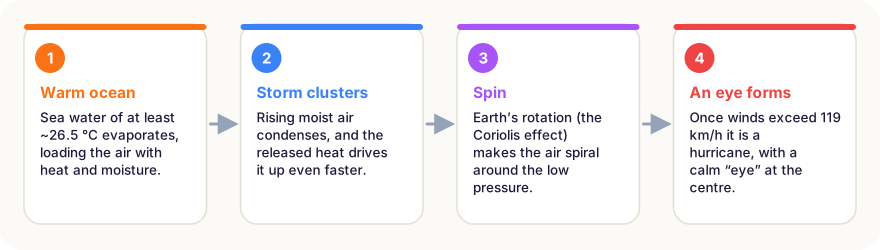
- Evaporation. Warm sea water evaporates, loading the air above with heat and water vapour.
- Rising and condensing. Moist air rises, cools and condenses into towering clouds. Condensation releases latent heat, warming the air and making it rise even faster.
- Falling pressure. As air rises, the pressure at the surface drops. Surrounding air rushes in to fill the gap, picking up more heat and moisture from the warm sea.
- Spin. Because Earth rotates, air moving towards the low-pressure centre is deflected, an effect called the Coriolis effect. In the Northern Hemisphere storms spin anticlockwise; in the Southern Hemisphere, clockwise.
- Organisation. As the system strengthens, it becomes a tropical depression, then a tropical storm, which receives a name. When sustained winds reach 119 km/h, it becomes a hurricane, and a calm eye often forms at its centre.
Inside a hurricane
At the centre is the eye, usually 30 to 65 kilometres across, where air gently sinks and skies can be almost clear. Around it is the eyewall, a ring of towering thunderstorms with the strongest winds and heaviest rain. Beyond it, spiral rainbands stretch outwards for hundreds of kilometres. People caught in the eye may think the storm has passed, only to be hit by the other side of the eyewall minutes or hours later.
Measuring hurricanes
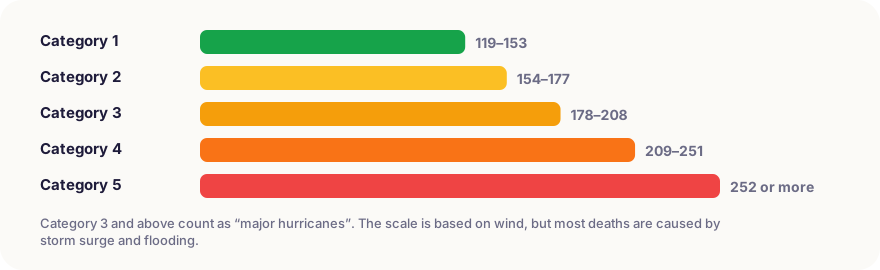
In the Atlantic and northeast Pacific, hurricanes are rated on the Saffir–Simpson scale according to their sustained winds:
| Category | Sustained winds | Typical damage |
|---|---|---|
| 1 | 119–153 km/h | Damage to roofs, trees and power lines |
| 2 | 154–177 km/h | Major roof damage, many trees uprooted |
| 3 (major) | 178–208 km/h | Serious damage to well-built homes |
| 4 (major) | 209–251 km/h | Severe damage; areas uninhabitable for weeks |
| 5 (major) | 252 km/h or more | Catastrophic; many homes destroyed |
Water, not wind, is the biggest killer
The scale is based on wind, but most hurricane deaths are caused by water:
- Storm surge: powerful winds and low pressure pile up seawater, which floods coasts. In 2005, Hurricane Katrina’s surge breached levees in New Orleans and flooded most of the city.
- Heavy rain: slow-moving storms can drop more than a metre of rain, causing flash floods far from the coast.
Same storm, different names
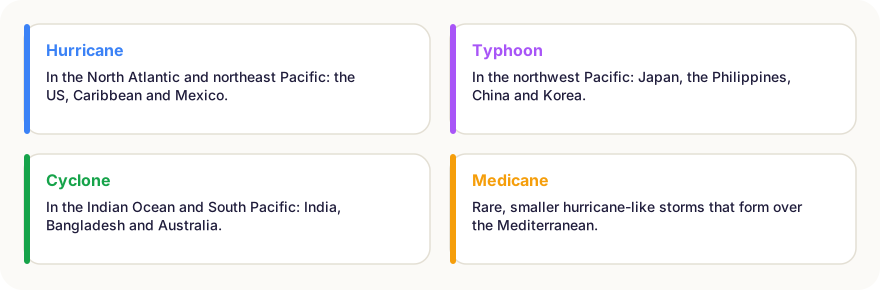
A hurricane in the Atlantic is a typhoon in the northwest Pacific and a cyclone in the Indian Ocean and South Pacific. They are the same type of storm. The Mediterranean occasionally produces smaller hurricane-like storms nicknamed medicanes. In September 2023, Storm Daniel, a medicane, caused catastrophic flooding in Libya, where two dams collapsed near the city of Derna.
Hurricanes and climate change
Scientists are studying how a warming climate affects these storms. In 2005, Kerry Emanuel reported that the destructive potential of tropical cyclones had increased markedly over the previous 30 years, linked to warmer oceans. A major assessment led by Thomas Knutson, published in 2019 and 2020, concluded that with further warming:
- the proportion of the most intense storms is likely to increase;
- storms are likely to produce more rainfall;
- storm surges will be made worse by rising sea levels.
The total number of storms may not increase, and could even decrease, but those that form are expected to be more dangerous on average.
Staying safe
Hurricanes can be tracked for days before landfall, thanks to satellites, aircraft that fly into the storms, and computer models. If you live in a hurricane area, know your evacuation route, follow official warnings, and remember that storm surge and flooding are often more dangerous than the wind.
In short
- Hurricanes form over warm oceans of at least about 26.5 °C.
- Rising moist air releases heat, lowering pressure and drawing in more air.
- The Coriolis effect makes the storm spin; hurricanes rarely form near the equator.
- They are rated on the Saffir–Simpson scale, from Category 1 to 5.
- Storm surge and flooding cause most hurricane deaths.
- A warmer climate is expected to make the strongest storms more common and rainier.
Frequently asked questions
What is the eye of a hurricane?
The eye is a calm, often clear area at the centre, typically 30 to 65 kilometres across, where air sinks. It is surrounded by the eyewall, a ring of towering thunderstorms with the strongest winds.
Why don’t hurricanes form at the equator?
The Coriolis effect, which makes storms spin, is almost zero at the equator. Hurricanes usually form at least about 5 degrees of latitude away from it.
Why do hurricanes weaken over land?
Over land they lose their supply of warm, moist air from the ocean, and friction with the ground slows the winds. However, they can still cause severe flooding far inland.
How are hurricanes named?
The World Meteorological Organization keeps rotating lists of names for each ocean region. Names of especially deadly or destructive storms, such as Katrina, are retired and replaced.
Sources
- NOAA National Hurricane Center – Tropical cyclone climatology
- Knutson, T. et al. (2019). Tropical cyclones and climate change assessment: Part I. Bulletin of the American Meteorological Society
- Emanuel, K. (2005). Increasing destructiveness of tropical cyclones over the past 30 years. Nature
This article is based on peer-reviewed research and publications from trusted institutions, and it is reviewed regularly. How we work →
You might also wonder
All in Earth & Nature →
How Are Mountains Formed? Colliding Plates, Volcanoes and the Rise of the Himalayas
Most mountains are built by colliding plates. How fold, volcanic and fault-block mountains form, why Everest still grows and how erosion wears them down.

How Do Snowflakes Form? Why They Have Six Sides and Are All Different
Every snowflake grows from a speck of dust in a cloud. Why snow crystals have six sides, how temperature shapes them, and whether no two are really alike.
What Causes Wind? Pressure, Sunshine and a Spinning Earth
Wind is air moving from high to low pressure, driven by the Sun heating Earth unevenly. How sea breezes, trade winds and the jet stream form, explained simply.
How Do Tornadoes Form? From Spinning Air to a Funnel Cloud
Most strong tornadoes grow out of supercell thunderstorms, where wind shear and rising air create a rotating column. How they form and how they are rated.
How Do Tsunamis Form? Why a Small Ripple at Sea Becomes a Wall of Water
Most tsunamis start when an undersea earthquake suddenly lifts the seafloor. How they cross oceans at jet speed, grow at the coast, and how to stay safe.

What Causes the Northern Lights? How the Aurora Gets Its Colours
The aurora is created when particles from the Sun hit gases high in our atmosphere. Why it glows green, red and purple, and where and when to see it.