How Are Mountains Formed? Colliding Plates, Volcanoes and the Rise of the Himalayas
Most mountains are built by colliding plates. How fold, volcanic and fault-block mountains form, why Everest still grows and how erosion wears them down.
Short answer
Most mountains form because Earth’s outer shell is broken into huge tectonic plates that move a few centimetres a year. Where two plates collide, the crust is squeezed, folded and thrust upwards over millions of years, creating fold mountains such as the Himalayas, the Alps and the Taurus Mountains. Volcanic mountains, like Mount Fuji and Mount Ararat, grow as erupted lava and ash pile up. Fault-block mountains form when the crust cracks and blocks are pushed up or drop down. At the same time, rain, ice and rivers erode mountains away, so their height is a balance between uplift and erosion.
In this article (7)
Mountains look like the most permanent things on Earth. Generations live and die beneath the same peaks. Yet on geological timescales, mountains are born, grow and wear away, and some are still rising today. Their story begins deep below our feet, with a planet whose surface is constantly on the move.
A planet of moving plates
Earth’s rigid outer layer, the lithosphere, is broken into about a dozen large tectonic plates and many smaller ones. They float on hotter, slowly flowing rock beneath and move at roughly the speed your fingernails grow, a few centimetres per year. According to the US Geological Survey, this theory of plate tectonics, accepted in the 1960s, explains earthquakes, volcanoes and the formation of most mountain ranges.
Where plates pull apart, new crust forms, as along the Mid-Atlantic Ridge, an underwater mountain chain. Where they collide, crust is crushed, thickened and pushed upwards. Where they slide past each other, they cause earthquakes, as along the North Anatolian Fault in Turkey.
Four ways to build a mountain
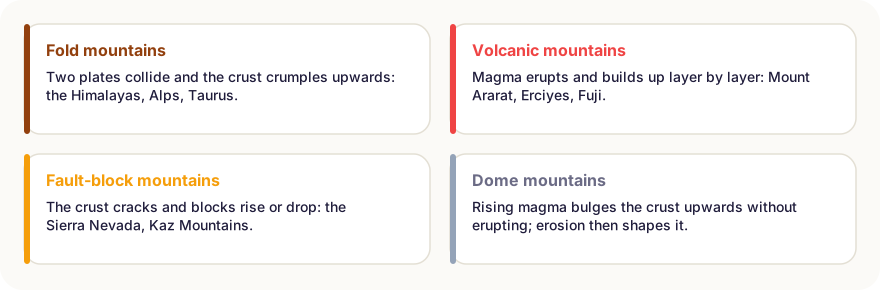
| Type | How it forms | Examples |
|---|---|---|
| Fold mountains | Two plates collide and the crust crumples and thickens | Himalayas, Alps, Taurus, Andes |
| Volcanic mountains | Lava and ash pile up around a vent | Mount Fuji, Mount Ararat, Mount Erciyes, Kilimanjaro |
| Fault-block mountains | The crust cracks, and blocks rise or sink | Sierra Nevada (USA), Harz (Germany) |
| Dome mountains | Magma pushes the crust up without erupting; erosion shapes it | Black Hills (USA) |
Fold mountains are the most common type of great range. When two continents collide, neither sinks easily, so the crust between them is squeezed like a rug pushed against a wall, folding and stacking up into enormous ridges.
Volcanic mountains grow where magma reaches the surface, often above subduction zones where one plate dives beneath another and melts, or over hot spots like Hawaii. Turkey’s highest peak, Mount Ararat (Ağrı Dağı), at 5,137 metres, is a volcano.
Fault-block mountains form when the crust is stretched or stressed until it breaks along faults. Some blocks are pushed up while others drop down, creating steep ranges next to flat valleys.
The birth of the Himalayas
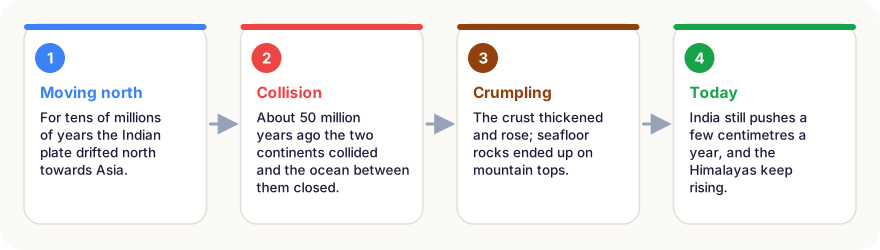
The Himalayas are the most dramatic example. Over 100 million years ago, the Indian plate broke away from an ancient southern supercontinent and began moving north, quite fast for a plate, at up to about 15 centimetres a year. An ocean called the Tethys lay between India and Asia.
About 50 million years ago, India collided with Asia. The ocean closed, and its sea-floor sediments were scraped up and crumpled. Because both landmasses were thick, light continental crust, neither could sink, so the crust thickened and rose. The result is the highest mountain range on Earth, home to all fourteen peaks over 8,000 metres.
That is why the summit of Everest is made of limestone containing fossils of sea creatures: those rocks once lay on the floor of the Tethys Ocean. India is still pushing into Asia by about 4 to 5 centimetres a year, and parts of the Himalayas are still rising by a few millimetres a year. The same collision causes frequent, sometimes devastating, earthquakes in the region.
How high can mountains get?
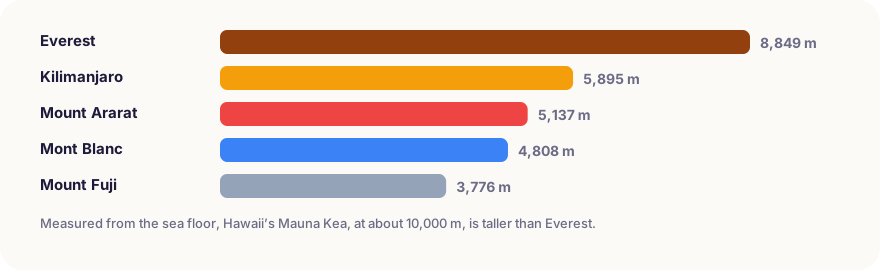
Everest is the highest mountain above sea level, at about 8,849 metres, a figure announced jointly by China and Nepal in 2020. But it depends how you measure:
- From base to summit, Mauna Kea in Hawaii rises about 10,000 metres from the sea floor.
- Because Earth bulges at the equator, Chimborazo in Ecuador has the summit farthest from Earth’s centre.
Mountains cannot grow forever. The higher they rise, the heavier they are, and the crust beneath sinks into the softer mantle, a balance called isostasy. Like icebergs, big mountains have deep roots.
Erosion: tearing mountains down
As soon as mountains rise, they begin to be destroyed. Rain, frost, glaciers and rivers break rock apart and carry it away. Glaciers carve sharp peaks and U-shaped valleys; rivers cut deep gorges.
Old mountain ranges show the result. The Appalachians in North America and the Scottish Highlands were once as high as the Himalayas, but hundreds of millions of years of erosion have worn them down to rounded hills. A mountain’s height at any moment is a contest between uplift and erosion.
Why mountains matter
Mountains shape climate and life. They force air to rise, cool and drop rain, so one side of a range is often wet and green while the other lies in a dry rain shadow. Their snow and glaciers feed rivers that supply water to billions of people, and their varied heights create many habitats, making mountains hotspots of biodiversity.
In short
- Most mountains are built by moving tectonic plates, a few centimetres a year.
- Fold mountains form where plates collide; volcanic mountains where magma erupts.
- Fault-block mountains form where the crust cracks and blocks rise or sink.
- The Himalayas formed when India hit Asia about 50 million years ago and are still rising.
- Everest is about 8,849 m high, and its summit holds fossils of sea creatures.
- Erosion constantly wears mountains down; old ranges become rounded hills.
Frequently asked questions
Is Mount Everest still growing?
Yes, slowly. India is still pushing into Asia, and parts of the Himalayas are rising by a few millimetres a year, though earthquakes and erosion also change the height.
What is the tallest mountain in the world?
Mount Everest is the highest above sea level, at about 8,849 metres. Measured from its base on the sea floor, Mauna Kea in Hawaii is taller, at about 10,000 metres.
How long does it take for mountains to form?
Usually millions to tens of millions of years. The Himalayas began rising about 50 million years ago. Volcanoes can be much faster: some grow hundreds of metres in a few decades.
Why do mountains have snow on top even in summer?
Air gets colder with height, by roughly 6.5 °C for every kilometre. High peaks stay below freezing for much of the year, so snow and glaciers can last all summer.
Sources
- US Geological Survey – This Dynamic Earth: the story of plate tectonics
- Encyclopaedia Britannica – Mountain
This article is based on peer-reviewed research and publications from trusted institutions, and it is reviewed regularly. How we work →
You might also wonder
All in Earth & Nature →
How Do Hurricanes Form? From Warm Ocean to Monster Storm
Hurricanes are giant storms powered by warm ocean water. How they form, why they spin, what the categories mean and how climate change affects them.

How Do Snowflakes Form? Why They Have Six Sides and Are All Different
Every snowflake grows from a speck of dust in a cloud. Why snow crystals have six sides, how temperature shapes them, and whether no two are really alike.

What Causes Wind? Pressure, Sunshine and a Spinning Earth
Wind is air moving from high to low pressure, driven by the Sun heating Earth unevenly. How sea breezes, trade winds and the jet stream form, explained simply.
How Do Tornadoes Form? From Spinning Air to a Funnel Cloud
Most strong tornadoes grow out of supercell thunderstorms, where wind shear and rising air create a rotating column. How they form and how they are rated.
How Do Tsunamis Form? Why a Small Ripple at Sea Becomes a Wall of Water
Most tsunamis start when an undersea earthquake suddenly lifts the seafloor. How they cross oceans at jet speed, grow at the coast, and how to stay safe.

What Causes the Northern Lights? How the Aurora Gets Its Colours
The aurora is created when particles from the Sun hit gases high in our atmosphere. Why it glows green, red and purple, and where and when to see it.