Why Is Venus So Hot? The Runaway Greenhouse Effect on Earth’s Twin
Venus is hotter than Mercury, though it is twice as far from the Sun. How its thick carbon dioxide air traps heat, and what Earth’s ‘evil twin’ teaches us.
Short answer
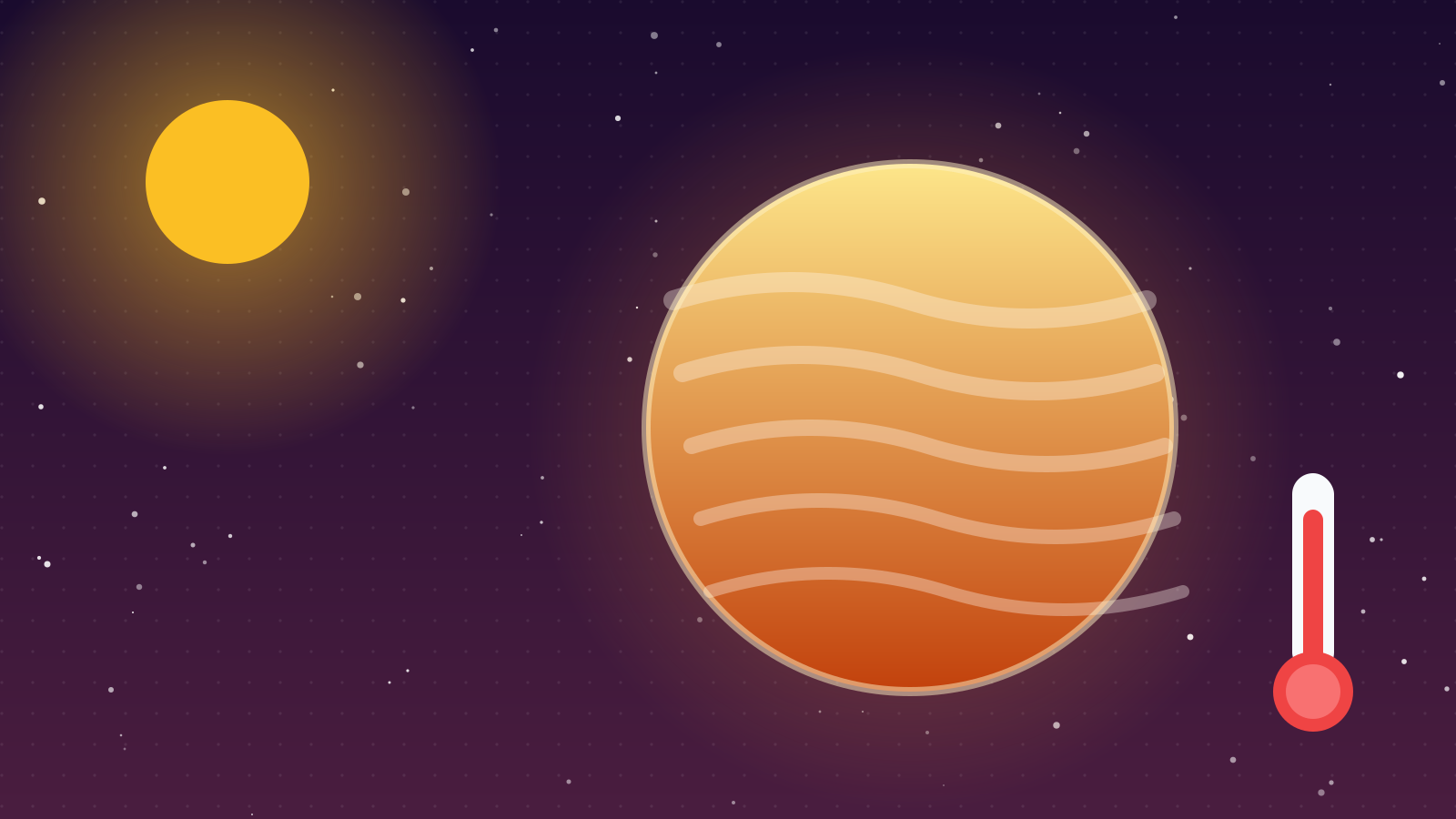
Venus is the hottest planet in the solar system, with a surface temperature of about 467 °C, hot enough to melt lead, because of a runaway greenhouse effect. Its atmosphere is about 96.5% carbon dioxide and so dense that the pressure at the surface is around 93 times that on Earth. Sunlight that gets through the thick sulfuric acid clouds warms the ground, but the heat the ground gives off as infrared radiation cannot escape through the carbon dioxide, so it builds up. That is why Venus is even hotter than Mercury, which is closer to the Sun but has almost no atmosphere to hold heat, and why Venus stays just as hot at night as during the day.
In this article (9)
At first glance, Venus seems like Earth’s twin. It is almost the same size, has a similar mass and a rocky surface, and it comes closer to Earth than any other planet. In the night sky, it shines brighter than any star. But beneath its bright, creamy clouds lies one of the most hostile places in the solar system: a scorching, crushing world where lead would melt and spacecraft cook within hours. NASA calls it Earth’s “evil twin”. So what went wrong?
Hotter than the planet closest to the Sun
Here is the puzzle. Venus is about twice as far from the Sun as Mercury, so it receives only about a quarter as much sunlight. Yet according to NASA, the surface of Venus averages about 467 °C, making it the hottest planet in the solar system.
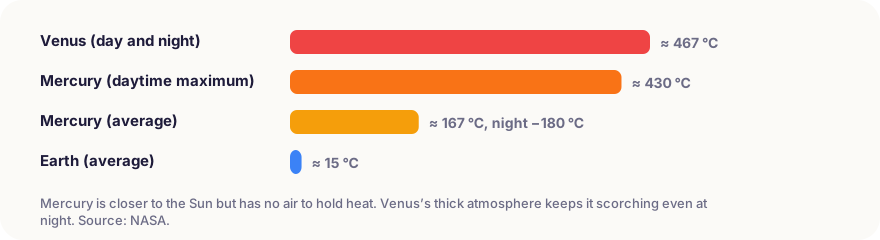
Mercury’s daytime side can reach about 430 °C, but at night it plunges to around −180 °C, because it has almost no atmosphere to hold heat. Venus, by contrast, is just as hot at the poles as at the equator, and at midnight as at noon. The difference is not distance from the Sun. It is air.
A crushing blanket of carbon dioxide
Venus’s atmosphere is extraordinarily thick. It is made of about 96.5% carbon dioxide, with some nitrogen, and the pressure at the surface is around 93 times that at sea level on Earth. NASA compares it to being about 900 metres deep in the ocean.
High above, between roughly 45 and 70 kilometres, lie dense layers of sulfuric acid clouds. These clouds reflect most of the sunlight that hits them, which is why Venus looks so bright. Only a small part of the sunlight reaches the ground, and yet that is enough to cook the surface.
The runaway greenhouse effect
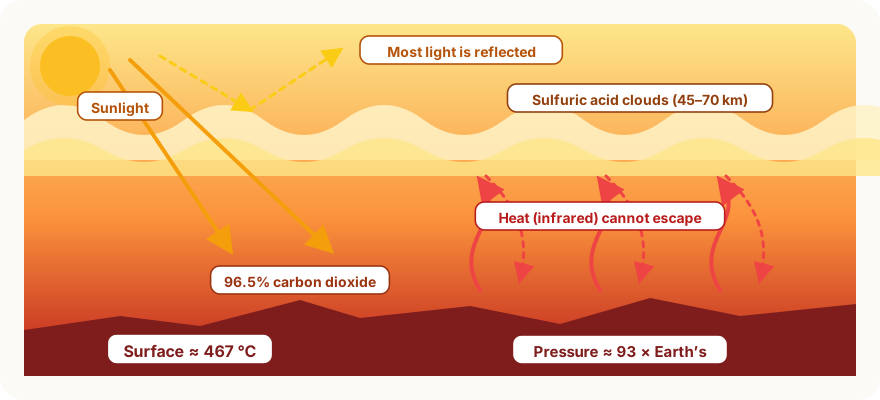
The greenhouse effect works the same way on every planet with an atmosphere:
- Visible sunlight passes through the air and warms the ground.
- The warm ground gives off energy as invisible infrared radiation (heat).
- Greenhouse gases such as carbon dioxide and water vapour absorb that infrared radiation and send part of it back down.
- The planet ends up warmer than it would be without an atmosphere.
On Earth, a moderate greenhouse effect is good news: without it, our average temperature would be well below freezing. On Venus, the effect has run out of control. There is so much carbon dioxide that almost no heat can escape to space. The surface keeps warming until it reaches about 467 °C, far above the melting point of lead, which is 327 °C.
How did Venus get this way?
Venus and Earth probably started out with similar ingredients, including water and carbon. Scientists think the main differences came from Venus being closer to the Sun.
One widely discussed scenario goes like this:
- Venus may once have had liquid water, perhaps even shallow oceans.
- As the young Sun grew brighter, water evaporated. Water vapour is itself a powerful greenhouse gas, so warming caused more evaporation and even more warming, a feedback loop.
- High in the atmosphere, sunlight split water molecules apart, and the light hydrogen escaped to space. The water was lost for good.
- Without water, carbon dioxide could no longer be locked away in rocks and oceans as it is on Earth. Volcanoes kept adding it to the air.
Whether Venus ever had oceans is still debated. ESA’s Venus Express mission, which orbited Venus from 2006 to 2014, found evidence that the planet is still losing hydrogen and oxygen to space today, a clue that it once had much more water.
A world of extremes
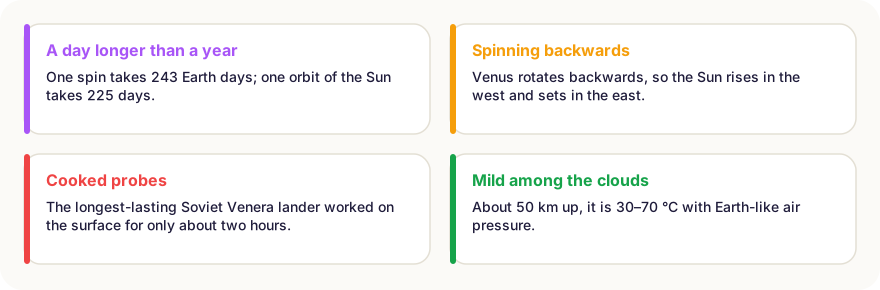
Heat is not the only strange thing about Venus:
| Feature | Venus | Earth |
|---|---|---|
| Surface temperature | ≈ 467 °C | ≈ 15 °C (average) |
| Surface pressure | ≈ 93 bar | 1 bar |
| Main gas | Carbon dioxide (96.5%) | Nitrogen (78%) |
| Clouds | Sulfuric acid | Water |
| Length of a day (one spin) | 243 Earth days | 24 hours |
| Length of a year | 225 Earth days | 365 days |
| Direction of spin | Backwards (retrograde) | Forwards |
Because Venus spins backwards, the Sun rises in the west and sets in the east. And because it spins so slowly, a single sunrise-to-sunset period lasts 117 Earth days.
Landing in an oven
Between 1961 and 1984, the Soviet Union sent a series of Venera probes to Venus. Ten reached the surface. They were built like armoured diving bells, yet the heat and pressure overwhelmed them. According to NASA, the longest-lasting lander survived about two hours, and the shortest only 23 minutes. Before they were cooked, some sent back photographs of a barren, rocky landscape under a dim, yellowish sky.
Could life exist in the clouds?
Surprisingly, about 50 kilometres above the surface, conditions are much milder. NASA notes that temperatures there are around 30 to 70 °C and the pressure is similar to Earth’s at sea level. Some scientists have speculated that hardy microbes could live in the cloud droplets, although the clouds are extremely acidic and no life has been found. Proposals for future crewed exploration often imagine floating stations at this height.
What Venus teaches us
Venus is a natural laboratory for understanding climate. It shows how strongly a planet’s temperature depends on its atmosphere, and how feedback loops can push a planet into a completely different state. Several new missions, including NASA’s VERITAS and DAVINCI and ESA’s EnVision, are planned to study Venus in the coming years and answer whether it was once a habitable world like ours.
In short
- Venus is the hottest planet, at about 467 °C, hotter than Mercury.
- Its air is 96.5% carbon dioxide, with surface pressure about 93 times Earth’s.
- A runaway greenhouse effect traps heat, so Venus is as hot at night as by day.
- Venus probably lost its water to space as the young Sun grew brighter.
- A day on Venus (243 days) is longer than its year (225 days), and it spins backwards.
- About 50 km up, the clouds are surprisingly mild, and future missions will study them.
Frequently asked questions
Is Venus hotter than Mercury?
Yes. Venus’s surface is about 467 °C day and night, while Mercury reaches about 430 °C in the day and falls to about −180 °C at night, because it has no thick atmosphere to trap heat.
Could humans ever land on Venus?
Not on the surface with current technology: the heat and pressure destroyed even the toughest Soviet landers within about two hours. Scientists have proposed floating stations about 50 km up, where conditions are milder.
Was Venus ever like Earth?
Possibly. Some models suggest Venus may once have had oceans and a milder climate before a runaway greenhouse effect took over, but this is still uncertain. Future missions aim to find out.
Can Earth become like Venus?
Not from today’s human-caused warming. Scientists say Earth’s climate change is serious, but a full Venus-like runaway greenhouse would require far more energy, such as a much brighter Sun in the distant future.
Sources
This article is based on peer-reviewed research and publications from trusted institutions, and it is reviewed regularly. How we work →
You might also wonder
All in Space →
How Big Is the Universe? From the Moon to the Edge of the Observable Cosmos
The observable universe is about 93 billion light years across, though only 13.8 billion years old. How that works and how big it might really be.
Is There Life on Mars? What We Know, What We’ve Found and What Comes Next
Mars once had rivers and lakes. Is anything alive there now? Clues from meteorites, methane and rovers, why the planet is so hostile and how we search.
What Are Comets? Dirty Snowballs, Glowing Tails and Visitors From the Edge of the Solar System
Comets are icy leftovers from the birth of the solar system. Why they grow tails near the Sun, where they come from and what the Rosetta mission found.
What Are Shooting Stars? Meteors, Meteor Showers and Where to See Them
Shooting stars are not stars at all. What makes those streaks of light, why do meteor showers happen on the same dates every year, and how can you see the most?
Why Does Saturn Have Rings? What They Are Made Of and How Old They Are
Saturn’s rings are made of billions of ice chunks, yet they are only metres thick. Where did they come from, why aren’t they a moon, and will they vanish?

Why Does the Moon Look Bigger on the Horizon? The Moon Illusion Explained
A rising full Moon looks huge, yet it is no bigger than when it is high in the sky. Why does our brain inflate it, and how can you prove the illusion yourself?