Why Does Metal Feel Colder Than Wood? The Physics of Touch and Temperature
A metal spoon and a wooden table in the same room are the same temperature, yet the metal feels colder. Why our skin senses heat flow, not temperature.
Short answer
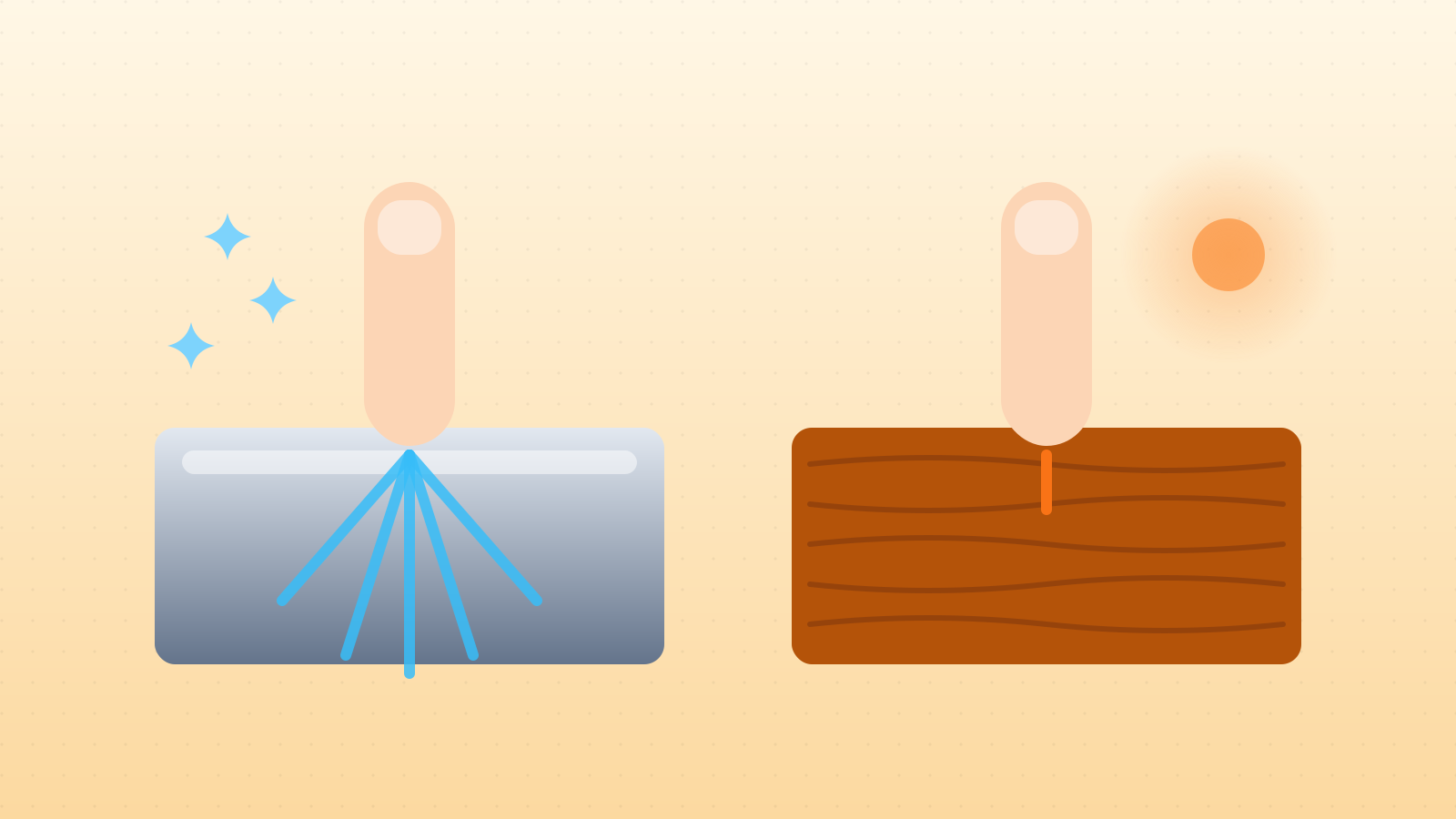
Metal feels colder than wood at the same temperature because metal conducts heat much faster. Your skin, at around 33 °C, is usually warmer than the objects around you. When you touch metal, heat flows rapidly out of your fingertip into the metal and is carried away, so the surface of your skin cools quickly. When you touch wood, which conducts heat thousands of times more poorly, heat stays near the point of contact and your skin barely cools. The temperature sensors in your skin react to the temperature of the skin itself and how fast it changes, not to the object’s temperature, so the metal feels cold and the wood feels warm, even though both are at room temperature.
In this article (8)
Walk barefoot from a carpeted bedroom onto a tiled bathroom floor on a winter morning and your feet will tell you the tiles are freezing. Pick up a metal spoon and then a wooden one, and the metal will feel cold while the wood feels almost warm. Yet if you held a thermometer against each, you would see the same number. The room, the tiles, the carpet, the spoons: they are all at the same temperature. So why do they feel so different?
Your skin does not measure temperature
The surprising answer is that your sense of touch is not a thermometer for objects. The temperature sensors in your skin, special nerve endings called thermoreceptors, respond mainly to the temperature of the skin itself and to how quickly that temperature changes.
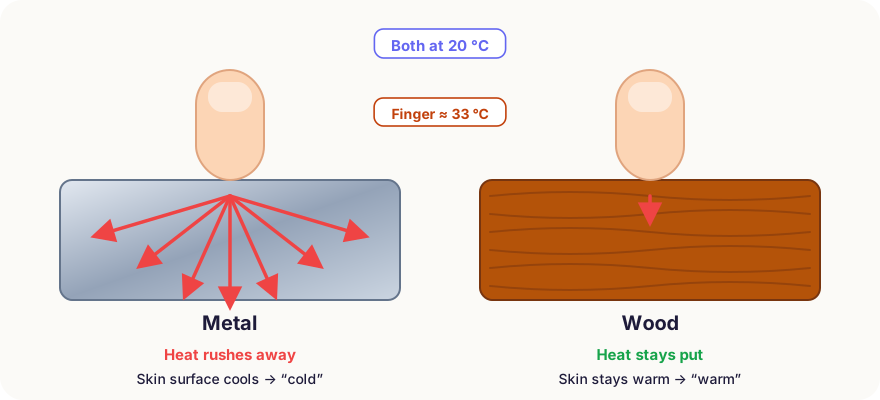
Your skin is usually around 30 to 34 °C, while a typical room is about 20 °C. Almost everything you touch is therefore cooler than you are, and heat flows from your skin into the object. What you feel as “cold” is really the speed at which heat is being drawn away from your skin.
Metal steals heat fast
Different materials pass heat along at very different rates. This property is called thermal conductivity.
- Metals are excellent conductors. They contain free-moving electrons that carry energy quickly through the material. When your warm fingertip touches metal, heat rushes from your skin into the metal and spreads away from the contact point. Your skin surface cools rapidly, and your nerves report “cold”.
- Wood is a poor conductor. It is made of cells with tiny pockets of air, and air is a very good insulator. Heat from your fingertip enters only the thin layer right under it, which quickly warms up. Very little heat flows away, so your skin stays warm and the wood feels pleasant.
How big is the difference?
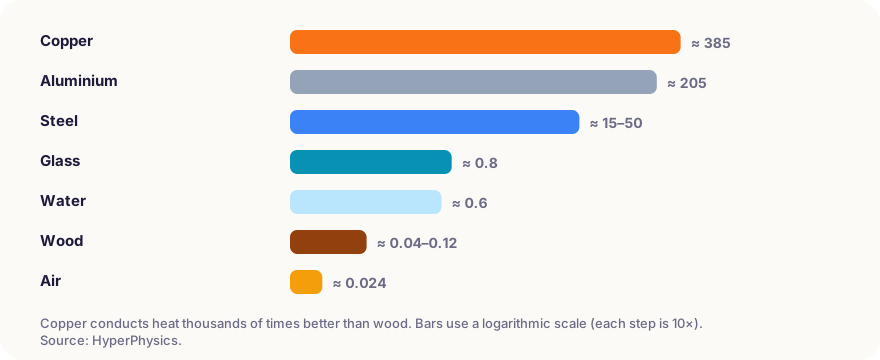
According to the thermal conductivity table of HyperPhysics, the physics resource of Georgia State University, the differences are enormous:
| Material | Thermal conductivity (W/m·K) | Feels… |
|---|---|---|
| Copper | ≈ 385 | Very cold |
| Aluminium | ≈ 205 | Very cold |
| Steel | ≈ 15–50 | Cold |
| Glass | ≈ 0.8 | Cool |
| Water | ≈ 0.6 | Cool |
| Wood | ≈ 0.04–0.12 | Warm |
| Air | ≈ 0.024 | Insulating |
Copper conducts heat thousands of times better than wood. That is why a copper pan heats evenly, and why its handle is often made of wood or plastic.
It is not only conductivity
Physicists add one refinement. What matters for the feeling of touch is not only how well a material conducts heat, but also how much heat it can soak up. A combination of conductivity, density and heat capacity, sometimes called thermal effusivity, describes how strongly a material pulls heat from whatever touches it. Metals score very high on this measure, while wood, cork and foam score very low.
The result is that when your finger touches metal, the contact temperature, the temperature where skin meets object, ends up close to the metal’s temperature. When your finger touches wood, the contact temperature stays close to your skin temperature. Your nerves feel the difference.
Hot works the same way
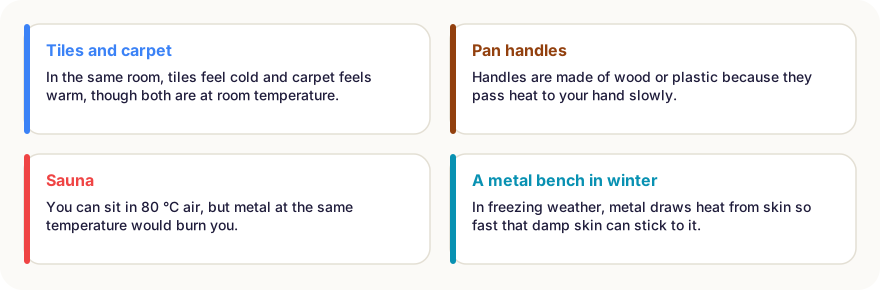
The effect works in reverse too. On a hot day, a metal slide or car door in the sun can feel scorching, while a wooden bench at the same temperature feels merely warm. In a sauna, people sit comfortably in air at 80 °C or more, because air delivers heat to the skin slowly. Metal at the same temperature would burn. That is also why sauna benches are made of wood.
Everyday examples
- Tiles vs carpet: tiles conduct heat well and feel cold underfoot; carpet traps air and feels warm.
- Pan handles: wooden or plastic handles keep heat from reaching your hand.
- Metal benches in winter: they can feel painfully cold, and in freezing weather wet skin can freeze to metal.
- Down jackets and wool: they work by trapping still air, one of the poorest conductors.
- Ice-cream scoops: some contain a conductive liquid that carries heat from your hand to the scoop’s edge, helping it slice through hard ice cream.
A lesson about our senses
The metal-and-wood puzzle is a good reminder that our senses do not measure the world directly. Your fingers detect energy flowing in or out of your skin, not the temperature of the thing you touch. That served our ancestors well: what matters for survival is whether something will take heat from your body or burn it, not what a thermometer would say.
In short
- Metal and wood in the same room are at the same temperature.
- Your skin senses its own temperature and how fast it changes, not the object’s temperature.
- Metals conduct heat thousands of times better than wood, so they draw heat from your skin fast.
- Wood contains air pockets and keeps heat near your fingertip, so it feels warm.
- The same effect makes hot metal feel hotter than hot wood.
- Tiles, carpets, pan handles and saunas all follow the same physics.
Frequently asked questions
Are metal and wood really the same temperature in a room?
Yes. Objects left in the same room for a while reach the same temperature as the air. A thermometer would show the same reading on both; only the feel is different.
Why do tiles feel colder than carpet?
Stone and ceramic tiles conduct heat much better than carpet, whose fibres trap insulating air. Bare feet lose heat quickly to tiles, so they feel cold, while carpet feels warm.
Why does metal stick to your tongue in freezing weather?
Metal pulls heat out of the wet surface so fast that the moisture freezes before your body can warm it, gluing skin to metal. That is why you should never lick metal poles in sub-zero temperatures.
Is metal colder outside in winter?
Metal outdoors is at the same temperature as other objects around it, but because it removes heat from your hands so quickly, touching it in winter can feel painfully cold and even cause frostbite in extreme cold.
Sources
- HyperPhysics (Georgia State University) – Thermal Conductivity table
- HyperPhysics (Georgia State University) – Heat Conduction
This article is based on peer-reviewed research and publications from trusted institutions, and it is reviewed regularly. How we work →
You might also wonder
All in Everyday Science →
What Is Fire? The Chemistry of Flames, Explained
Fire is a fast reaction between fuel and oxygen that releases heat and light. What a flame really is, why flames are yellow or blue and how fires are put out.

Why Does Bread Rise? Yeast, Gluten and the Science of a Perfect Loaf
Bread rises because yeast makes carbon dioxide that a stretchy gluten network traps like tiny balloons. How fermentation, kneading and baking work.

How Does Soap Work? The Two-Faced Molecule That Cleans
Water alone can’t wash away grease, but soap can. How soap molecules trap oil in micelles, why they destroy some viruses and why 20 seconds matter.
Why Do Apples Turn Brown? Enzymatic Browning and How to Stop It
A cut apple turns brown within minutes because an enzyme reacts with oxygen. What happens, why lemon juice helps, and whether brown apple is safe to eat.
Why Does Bread Go Stale? It Isn’t Just Drying Out
Stale bread isn’t simply dry: its starch slowly recrystallises. Why bread stales faster in the fridge, why toasting revives it and the best way to store it.
Why Is Glass Transparent When Sand Is Not? The Physics of Clear Glass
Glass is made from sand, yet light passes straight through it. Why glass is clear, why it blocks some ultraviolet, and whether old windows really flow.