Why Does Bread Rise? Yeast, Gluten and the Science of a Perfect Loaf
Bread rises because yeast makes carbon dioxide that a stretchy gluten network traps like tiny balloons. How fermentation, kneading and baking work.
Short answer
Bread rises because of yeast and gluten working together. Yeast is a living single-celled fungus that feeds on sugars in the flour and, through fermentation, produces carbon dioxide gas and a little alcohol. Meanwhile, mixing and kneading flour with water turns two wheat proteins into gluten, a stretchy, elastic network. This network traps the carbon dioxide in countless tiny bubbles, so the dough swells like a sponge full of balloons. In the oven, the heat makes the gas expand and the water and alcohol evaporate, giving a final burst of rising, before the starch and proteins set into the soft, airy crumb and the crust browns.
In this article (7)
Mix flour, water, salt and a spoonful of yeast, leave it in a warm place, and something almost magical happens. A heavy, sticky lump slowly swells to twice its size, and in the oven it becomes a light, airy loaf with a golden crust. Bread has fed people for thousands of years, but the reason it rises is a beautiful combination of biology, chemistry and physics.
The living ingredient: yeast
Baker’s yeast, Saccharomyces cerevisiae, is a single-celled fungus. A small block contains billions of living cells. When mixed with water and flour, they wake up and start feeding on sugars. Some sugars are present in flour; others are released as natural enzymes break down starch.
Yeast turns these sugars into energy through fermentation. The waste products are carbon dioxide gas and ethanol, the same alcohol found in beer, along with many small molecules that give bread its flavour and aroma. In bread making it is the gas that matters most.
The stretchy net: gluten
Gas alone cannot make bread rise; it would simply bubble away. The dough needs something to hold it. That something is gluten.
Wheat flour contains two main proteins, glutenin and gliadin. When flour is mixed with water and kneaded, they link up and form gluten, a network that is both stretchy and elastic, a bit like chewing gum. As carbon dioxide forms, it inflates countless tiny bubbles in the dough, and the gluten stretches around them like the walls of microscopic balloons.
From dough to loaf
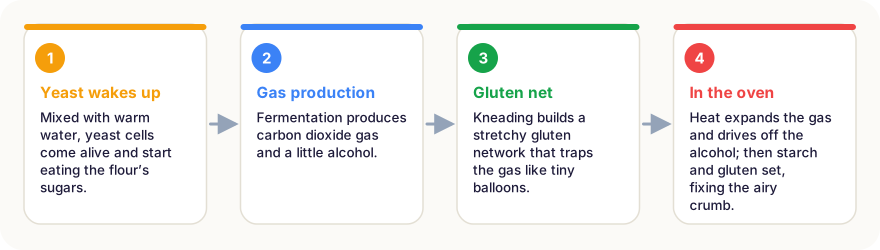
- Mixing and kneading build the gluten network and spread the yeast through the dough.
- Proofing (rising): in a warm place, around 24–30 °C, the yeast produces gas and the dough typically doubles in size over one to two hours. Many bakers knock the dough back and let it rise again for a finer texture.
- Oven spring: in the hot oven, the gas bubbles expand, and water and alcohol turn to vapour, giving the loaf one last surge in size during the first minutes of baking.
- Setting: as the inside heats up, the yeast dies above about 50–60 °C, starch absorbs water and gelatinises, and the gluten firms up. The airy structure is fixed in place.
- Browning: at the surface, temperatures rise far higher. The Maillard reaction between sugars and proteins, together with caramelisation, creates the golden-brown crust and much of the delicious smell of fresh bread.
Different ways to make dough rise
| Raising agent | How it makes gas | Speed | Typical use |
|---|---|---|---|
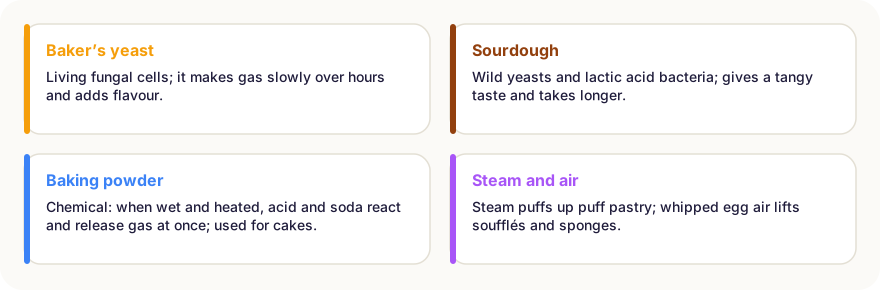
| Baker’s yeast | Fermentation by living yeast cells | Hours | Bread, pizza, buns |
| Sourdough starter | Wild yeasts plus lactic acid bacteria | Many hours to days | Sourdough bread, rye bread |
| Baking powder | Acid and bicarbonate react when wet and heated | Minutes | Cakes, muffins |
| Baking soda | Reacts with an acidic ingredient such as yoghurt | Minutes | Soda bread, cookies |
| Steam | Water in the dough vaporises in the oven | During baking | Puff pastry, choux pastry |
| Beaten air | Air whisked into eggs or butter | During mixing | Sponge cake, soufflé |
Sourdough is the oldest method. A starter made simply from flour and water collects wild yeasts and lactic acid bacteria from the environment. The bacteria produce acids that give sourdough its tangy flavour and help it keep longer.
Why bread sometimes fails
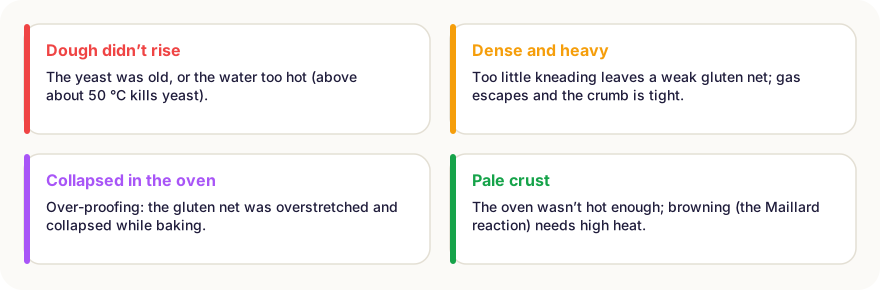
- The dough doesn’t rise: the yeast may be old, or the water too hot. Water above about 50 °C can kill yeast.
- The bread is dense and heavy: too little kneading or too weak a flour means the gluten network cannot hold the gas.
- The loaf collapses in the oven: the dough was over-proofed. The gluten was stretched too thin and could not support the expansion.
- The crust is pale: the oven was not hot enough for browning.
- The bread tastes flat: salt was forgotten. Salt adds flavour and also strengthens the gluten and slows the yeast slightly.
Flour matters
Not all flours behave the same. Bread flour is made from wheat with more protein, which forms more gluten, ideal for chewy loaves. Cake flour has less protein for a tender crumb. Rye has proteins that form much weaker gluten, which is why rye bread is denser and often made with sourdough. Gluten-free breads use substitutes such as xanthan gum or psyllium husk to mimic gluten’s stretch.
In short
- Yeast is a living fungus that ferments sugars into carbon dioxide and a little alcohol.
- Gluten, formed by kneading wheat proteins with water, traps the gas in tiny bubbles.
- Dough rises in a warm place, then gets a final oven spring as gas expands.
- Heat sets the starch and gluten, and the Maillard reaction browns the crust.
- Sourdough, baking powder, steam and beaten air are other ways to make dough rise.
- Old yeast, hot water, too little kneading or over-proofing are common causes of failure.
Frequently asked questions
Why does bread dough need to be kneaded?
Kneading stretches and aligns the gluten proteins into a strong, elastic network that can trap gas. Without enough kneading, the gas escapes and the bread stays flat and dense.
Does the alcohol in bread dough stay in the bread?
Almost all of it evaporates during baking. Freshly baked bread can contain tiny traces, but far too little to have any effect.
Why doesn’t gluten-free bread rise as well?
Without gluten there is no natural stretchy network to trap gas. Gluten-free recipes use ingredients such as xanthan gum or psyllium to imitate it, but the texture is usually denser.
What is the best temperature for bread to rise?
Yeast works well at about 24–30 °C. Colder dough rises more slowly, which can improve flavour; above about 50 °C the yeast begins to die.
Sources
- Struyf, N. et al. (2017). Bread dough and baker’s yeast: an uplifting synergy. Comprehensive Reviews in Food Science and Food Safety
- Encyclopaedia Britannica – Bread
This article is based on peer-reviewed research and publications from trusted institutions, and it is reviewed regularly. How we work →
You might also wonder
All in Everyday Science →
What Is Fire? The Chemistry of Flames, Explained
Fire is a fast reaction between fuel and oxygen that releases heat and light. What a flame really is, why flames are yellow or blue and how fires are put out.

How Does Soap Work? The Two-Faced Molecule That Cleans
Water alone can’t wash away grease, but soap can. How soap molecules trap oil in micelles, why they destroy some viruses and why 20 seconds matter.
Why Do Apples Turn Brown? Enzymatic Browning and How to Stop It
A cut apple turns brown within minutes because an enzyme reacts with oxygen. What happens, why lemon juice helps, and whether brown apple is safe to eat.
Why Does Bread Go Stale? It Isn’t Just Drying Out
Stale bread isn’t simply dry: its starch slowly recrystallises. Why bread stales faster in the fridge, why toasting revives it and the best way to store it.
Why Is Glass Transparent When Sand Is Not? The Physics of Clear Glass
Glass is made from sand, yet light passes straight through it. Why glass is clear, why it blocks some ultraviolet, and whether old windows really flow.
Does Hot Water Freeze Faster Than Cold? The Mpemba Effect Explained
A Tanzanian schoolboy claimed hot water freezes faster than cold. Is the Mpemba effect real? The proposed explanations and what careful experiments found.