What Is Fire? The Chemistry of Flames, Explained
Fire is a fast reaction between fuel and oxygen that releases heat and light. What a flame really is, why flames are yellow or blue and how fires are put out.
Short answer
Fire is a rapid chemical reaction called combustion, in which a fuel combines with oxygen and releases energy as heat and light. A fire needs three things, known as the fire triangle: fuel, oxygen and enough heat. When a fuel such as wood is heated, it releases flammable gases, and it is these gases that actually burn. The flame is a region of hot, glowing gas where the reaction takes place. Its yellow colour comes from tiny soot particles glowing at over 1,000 °C, while blue flames come directly from the chemistry when burning is more complete. Remove any side of the triangle and the fire goes out.
In this article (9)
Fire has been part of human life for hundreds of thousands of years. It cooked our food, kept us warm, scared away predators and lit up the night. We light candles on birthday cakes, gather around campfires and use flames in engines and power stations. Yet most of us would struggle to say what fire actually is. Is it a thing? A substance? A form of energy?
Fire is a chemical reaction
Fire is not a substance but a process: a fast chemical reaction called combustion. During combustion, a fuel reacts with oxygen and releases energy as heat and light. For wood, paper, gas or wax, the main products are carbon dioxide and water vapour, along with smoke, soot and ash if burning is incomplete.
The reaction releases more heat than it needs to keep going. That extra heat warms nearby fuel, which starts reacting too. This is why a fire can grow and spread on its own.
The fire triangle
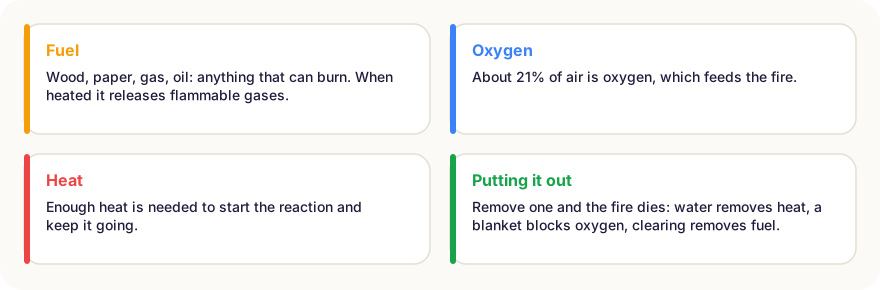
A fire needs three ingredients, often drawn as the fire triangle:
- Fuel: anything that can burn, such as wood, paper, fabric, oil, petrol or gas.
- Oxygen: about 21% of air is oxygen, which is plenty for most fires.
- Heat: enough to raise the fuel to its ignition temperature and keep the reaction going.
Firefighters often add a fourth element, the chemical chain reaction itself, forming a fire “tetrahedron”. Some extinguishers work by interrupting that chain.
What burns is the gas
Here is a surprise: solid wood does not really burn. When wood is heated, it breaks down and releases flammable gases, a process called pyrolysis. It is these gases, mixing with oxygen, that burn in the flames. That is why flames dance above a log rather than sitting on its surface. Glowing embers are different: there, the carbon left behind, charcoal, reacts directly with oxygen without a flame.
Inside a candle flame
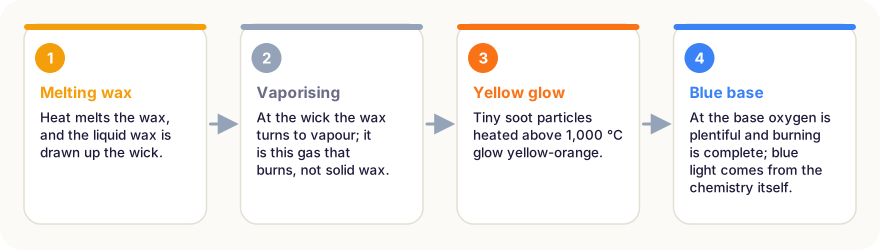
A candle is a perfect laboratory. In the 1840s, scientist Michael Faraday gave a famous series of lectures for young people, The Chemical History of a Candle, using it to explain combustion.
- The heat of the flame melts the wax near the wick.
- The liquid wax is drawn up the wick by capillary action, like water soaking up a paper towel.
- Near the top of the wick, the wax vaporises into a gas.
- The wax vapour mixes with oxygen from the air and burns, producing heat that melts more wax.
The flame has distinct zones. The dark core near the wick is unburnt wax vapour. The bright yellow region glows because tiny particles of soot, unburnt carbon, are heated to over 1,000 °C and shine like the filament of an old light bulb. At the blue base, where oxygen is plentiful, burning is more complete, and the blue light comes directly from excited molecules created by the chemical reaction.
Why flames have different colours
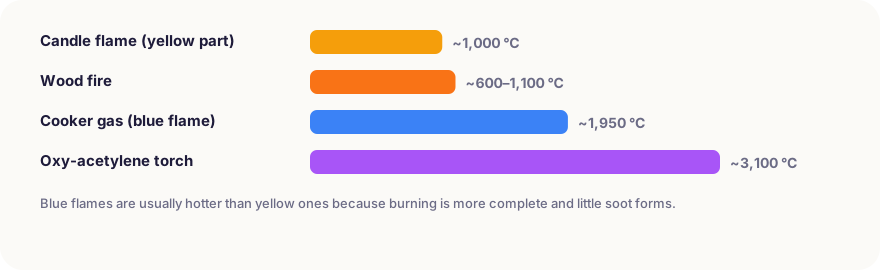
- Yellow and orange flames, from candles, wood and campfires, contain glowing soot. They are usually cooler and produce more smoke.
- Blue flames, like those on a gas cooker, burn with plenty of oxygen and produce little soot. They are usually hotter.
- Other colours come from chemical elements. Copper gives green or blue flames, sodium bright yellow, strontium red and potassium lilac. Fireworks use these to create their colours.
Why flames point upwards
On Earth, the hot gases of a flame are less dense than the surrounding air, so they rise. That draws fresh, oxygen-rich air in at the bottom and gives flames their teardrop shape. In microgravity, there is no “up”. Experiments on the Space Shuttle and the International Space Station, described by researchers such as Daniel Dietrich, showed that candle flames become spherical and dim blue, because oxygen only reaches them slowly by diffusion.
How to put a fire out
Remove one side of the fire triangle, and the fire dies:
| Method | Which side it removes | Example |
|---|---|---|
| Water | Heat (cools the fuel) | Wood and paper fires |
| Fire blanket or lid | Oxygen (smothers the flame) | A pan of burning oil |
| Carbon dioxide extinguisher | Oxygen and heat | Electrical equipment |
| Removing fuel | Fuel | Firebreaks in forests |
| Dry powder | The chemical chain reaction | Many mixed fires |
Never throw water on a burning pan of oil: the water instantly turns to steam and hurls burning oil into the air. Turn off the heat and cover the pan instead.
Staying safe
Most deaths in house fires are caused not by flames but by smoke, which contains toxic gases such as carbon monoxide. Fire safety agencies recommend having working smoke alarms on every floor, testing them regularly, never leaving cooking unattended and planning how to get out of your home quickly if a fire starts.
In short
- Fire is combustion: a fast reaction between fuel and oxygen that releases heat and light.
- It needs the fire triangle: fuel, oxygen and heat.
- Solid fuels release flammable gases when heated; the gases burn in the flame.
- Yellow flames glow from hot soot; blue flames burn more completely and are usually hotter.
- In space, flames are round and blue because hot gas does not rise.
- Remove fuel, oxygen or heat to put a fire out; never use water on burning oil.
Frequently asked questions
Is fire a solid, liquid or gas?
None exactly. A flame is mostly hot gas undergoing a chemical reaction, with glowing soot particles in it. In very hot flames some of the gas can become ionised, a little like plasma.
Why do flames point upwards?
Hot gas from the flame is less dense than the surrounding air, so it rises, drawing in fresh air at the bottom. This flow shapes the flame into a teardrop. In space, without this effect, flames become spherical.
Why shouldn’t you throw water on a cooking-oil fire?
Water sinks into the hot oil, instantly boils into steam and throws burning oil into the air, spreading the fire violently. Turn off the heat and cover the pan with a lid or a fire blanket instead.
What kills most people in house fires?
Smoke, not flames. Toxic gases such as carbon monoxide and the lack of oxygen cause most fire deaths, which is why working smoke alarms save so many lives.
Sources
- Dietrich, D. L. et al. (2000). Candle flames in non-buoyant atmospheres. Combustion Science and Technology
- US Fire Administration – Home fires
- Encyclopaedia Britannica – Flame
This article is based on peer-reviewed research and publications from trusted institutions, and it is reviewed regularly. How we work →
You might also wonder
All in Everyday Science →
Why Does Bread Rise? Yeast, Gluten and the Science of a Perfect Loaf
Bread rises because yeast makes carbon dioxide that a stretchy gluten network traps like tiny balloons. How fermentation, kneading and baking work.
How Does Soap Work? The Two-Faced Molecule That Cleans
Water alone can’t wash away grease, but soap can. How soap molecules trap oil in micelles, why they destroy some viruses and why 20 seconds matter.
Why Do Apples Turn Brown? Enzymatic Browning and How to Stop It
A cut apple turns brown within minutes because an enzyme reacts with oxygen. What happens, why lemon juice helps, and whether brown apple is safe to eat.
Why Does Bread Go Stale? It Isn’t Just Drying Out
Stale bread isn’t simply dry: its starch slowly recrystallises. Why bread stales faster in the fridge, why toasting revives it and the best way to store it.
Why Is Glass Transparent When Sand Is Not? The Physics of Clear Glass
Glass is made from sand, yet light passes straight through it. Why glass is clear, why it blocks some ultraviolet, and whether old windows really flow.
Does Hot Water Freeze Faster Than Cold? The Mpemba Effect Explained
A Tanzanian schoolboy claimed hot water freezes faster than cold. Is the Mpemba effect real? The proposed explanations and what careful experiments found.