Why Do We Get Goosebumps? The Science of Chills
Why do we get goosebumps when we are cold, scared or listening to a favourite song? The evolutionary story of a tiny muscle at the base of every hair.
Short answer
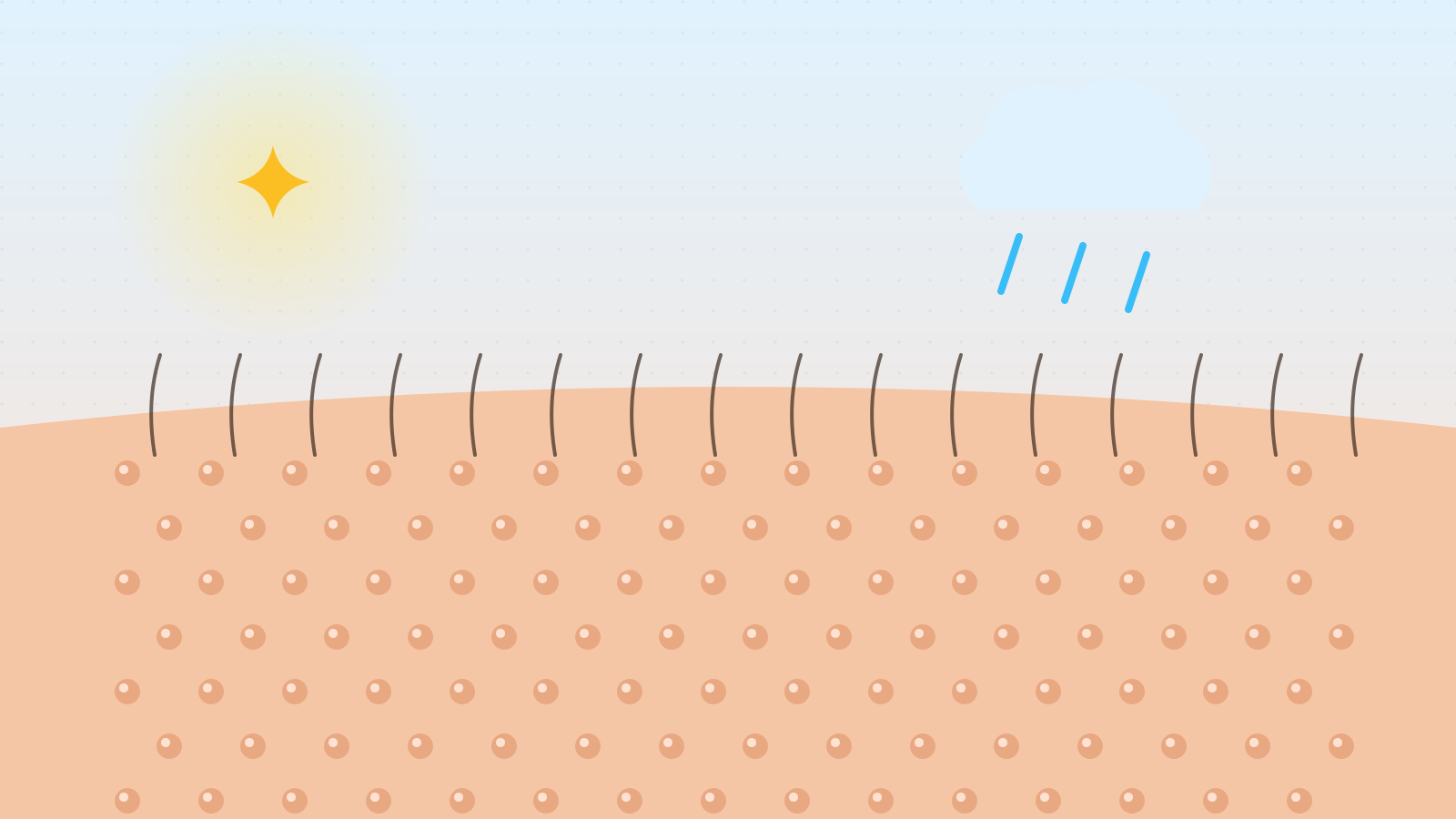
At the base of each hair sits a tiny muscle called the arrector pili. In the cold, in fear or during a strong emotion, the sympathetic nervous system makes these muscles contract. They pull the hairs upright and push up the skin around them, creating goosebumps. In furry animals this insulates the body and makes the animal look bigger; in humans it survives as a reflex inherited from our ancestors.
In this article (7)
Step outside on a cold morning, watch a tense scene in a horror film or reach the chorus of a favourite song, and the hairs on your arms suddenly stand up as your skin breaks out in tiny bumps. That familiar feeling is a reflex millions of years old — and a reminder that humans were once much hairier creatures.
The tiny muscle that raises your skin
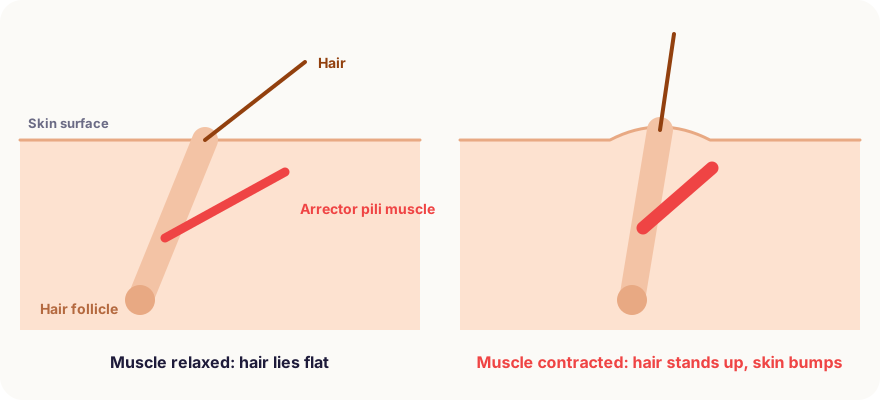
At the base of almost every hair on your body sits a muscle too small to see: the arrector pili. One end attaches to the hair follicle, the pocket that holds the hair root, and the other to the upper layer of the skin.
When the muscle is relaxed, the hair lies at an angle against the skin. When it contracts, it:
- Pulls on the hair root and stands the hair upright.
- Pushes the follicle upwards, raising the skin around it.
- Creates a little dimple and bump around each hair — the “plucked goose” look that gives goosebumps their name.
We do not control these muscles. They are switched on by the sympathetic nervous system, which runs involuntary functions such as heart rate and digestion. The sympathetic system is also the centre of the body’s “fight or flight” response, which is why our hair stands on end when we are frightened.
Two jobs inherited from furry ancestors
To see what goosebumps are really for, look at furry animals. In them the reflex does two important things.
Insulation
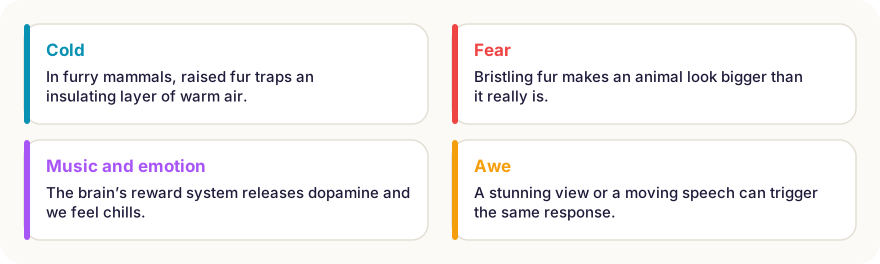
When fur is fluffed up in the cold, it traps a layer of still air between the hairs. Air conducts heat poorly, so this layer slows the loss of body heat, much like a down duvet. Birds and cats that look puffed up in winter are using exactly this insulation.
Intimidation
When a frightened or threatened animal raises its fur, it looks bigger than it really is. A cat arching its back with bristling fur, or a porcupine raising its quills, sends a clear message: “Don’t mess with me.”
During evolution humans lost most of their thick body hair, but the nerves and muscles controlling the reflex stayed. So when we get goosebumps today, we neither warm up nor look scarier — our body simply keeps running the old program.
A new finding: more than a leftover?
For many years human goosebumps were seen as a useless evolutionary remnant. In 2020, a study by Ya-Chieh Hsu and colleagues at Harvard University, published in Cell, nudged that view.
Working with mice, the researchers discovered that:
- The arrector pili muscle acts as a bridge that lets a sympathetic nerve reach the hair follicle.
- The sympathetic nerve does not just contract the muscle; it also connects directly to stem cells in the hair follicle.
- During prolonged cold, these nerves stimulate the stem cells and kick-start new hair growth.
So the same system that raises hairs for instant insulation may, in the longer term, help the coat grow thicker. These findings come from mice, and how far the same relationship holds in human skin is still being investigated.
Emotional chills: why does music give us goosebumps?
Perhaps the most intriguing kind of goosebumps are the ones we get at the climax of a song or during a moving film scene — when there is no cold and no real danger. Scientists call this experience frisson, French for “shiver”.
In a 2011 study at McGill University, volunteers listened to music that gave them chills while their brains were scanned. The results showed that:
- As the music built towards its peak, dopamine release rose in brain regions linked to anticipation.
- At the moment of the chill, dopamine rose in regions at the heart of reward and pleasure.
Dopamine is a brain chemical released during pleasurable experiences such as eating or receiving a reward. Music, despite not being a tangible reward, can activate a similar system. Chills often arrive with an unexpected change in harmony, a sudden rise in volume or the surprise entrance of a new voice.
Not everyone experiences this equally. Research suggests that people who are more open to new experiences get musical chills more often.
How the body really keeps warm
In humans, goosebumps do little to keep us warm. The body has much more effective defences against the cold:
| Response | How it works | Effect |
|---|---|---|
| Narrowing blood vessels | Less blood flows to the skin, keeping heat inside | Strong |
| Shivering | Muscles rapidly contract and relax, producing heat | Strong |
| Brown fat | Burns fat to produce heat directly | Moderate |
| Goosebumps | Fine hairs trap a little air | Very weak |
Even so, goosebumps are often a precursor to shivering — an early signal that the body needs to conserve heat.
Goosebumps on command
Some people say they can raise goosebumps simply by concentrating, without any outside trigger. The ability is very rare and has been looked at in small studies. That some people can consciously trigger a response normally considered involuntary suggests the link between the brain and the autonomic nervous system may be more flexible than we think.
In short
Goosebumps happen when a tiny muscle at the base of each hair is contracted by the sympathetic nervous system. In our furry ancestors the reflex kept them warm and helped them look intimidating; in us it lingers mostly as an evolutionary memento. Yet the same system may play a part in hair growth — and it shows just how deeply abstract experiences such as music can move us.
Frequently asked questions
What is the medical name for goosebumps?
The scientific term is piloerection. Because of the skin’s appearance it is also called cutis anserina, literally “goose skin”.
Why do we get chills from music?
Emotionally powerful moments in music trigger dopamine release in the brain’s reward system, while the sympathetic nervous system is also activated, raising goosebumps. A large share of people experience these musical chills.
Are there people who never get goosebumps?
It is very rare. Some people can even raise goosebumps at will, while others say they hardly ever experience emotional chills.
Do goosebumps actually keep us warm?
Not really in humans. Our body hair is too fine and sparse to trap a meaningful layer of air. Shivering and narrowing blood vessels do the real warming work.
Sources
- Shwartz et al. (2020) – Cell Types Promoting Goosebumps Form a Niche to Regulate Hair Follicle Stem Cells, Cell
- Salimpoor et al. (2011) – Anatomically distinct dopamine release during anticipation and experience of peak emotion to music, Nature Neuroscience
This article is based on peer-reviewed research and publications from trusted institutions, and it is reviewed regularly. How we work →
You might also wonder
All in Human Body →
Why Do Fingers Wrinkle in Water? Your Nervous System’s Surprising Trick
Why do fingertips prune after a long bath? It is not just skin soaking up water — it is your nervous system at work. Plus the debate over what wrinkles are for.
Why Do We Yawn? The Science of Contagious Yawning
Do we yawn because we are tired, bored or low on oxygen? The brain-cooling theory and why seeing someone yawn makes you yawn too, explained with research.
Why Does Hair Turn Grey? Stress, Genes and Stem Cells in the Follicle
Why does hair go grey, can stress really turn it white and can grey hair come back? The pigment cells in hair follicles and what new research has found.
Why Are Fingerprints Unique? A Pattern That Begins in the Womb
How do fingerprints form, why do even identical twins have different prints, and what are fingerprints for? The 2023 discovery and the science behind them.
What Causes Brain Freeze? The Secret of the Ice-Cream Headache
What is that sharp pain in your forehead when you eat something cold? How brain freeze happens, why you feel it in your forehead and how to make it stop.
Why Does Your Stomach Growl? Hunger Noises and the Gut’s Cleaning Cycle
Why does your stomach rumble when you are hungry, and does it growl when you are full? Where gut sounds come from and the cleaning cycle of an empty gut.