What Is the Mandela Effect? Why Thousands of People Share the Same False Memories
Many people remember the Monopoly man’s monocle or a black tip on Pikachu’s tail, yet neither exists. What the Mandela effect is and what memory science says.
Short answer
The Mandela effect is the name for false memories shared by large numbers of people, such as remembering that the Monopoly man wears a monocle or that Pikachu’s tail has a black tip, when neither is true. The term comes from blogger Fiona Broome, who found that many people, like her, wrongly remembered Nelson Mandela dying in prison in the 1980s; he actually died in 2013. Psychologists explain it with how memory works: the brain stores the gist of things and rebuilds details when we remember, filling gaps with expectations, similar images and things we have heard since. A 2022 study confirmed that some images trigger the same specific false memory in many people, with high confidence.
In this article (8)
Picture the little mustachioed man from the Monopoly board game. Is he wearing a monocle? Most people say yes, and they are sure. But he never has. Now think of Darth Vader’s famous line in The Empire Strikes Back. “Luke, I am your father”? The actual line is “No, I am your father.” These are examples of the Mandela effect: false memories shared by thousands, sometimes millions, of people. Why would so many minds make the same mistake?
Where the name comes from
Around 2009 to 2010, the writer and blogger Fiona Broome was surprised to discover that she was not alone in a strange memory. She, and many others she met, clearly remembered that Nelson Mandela had died in prison in the 1980s, with news coverage and a funeral. In reality, Mandela was released in 1990, became South Africa’s first Black president in 1994 and died in 2013. Broome called these widely shared false memories the “Mandela effect”, and the name spread rapidly online.
Famous examples
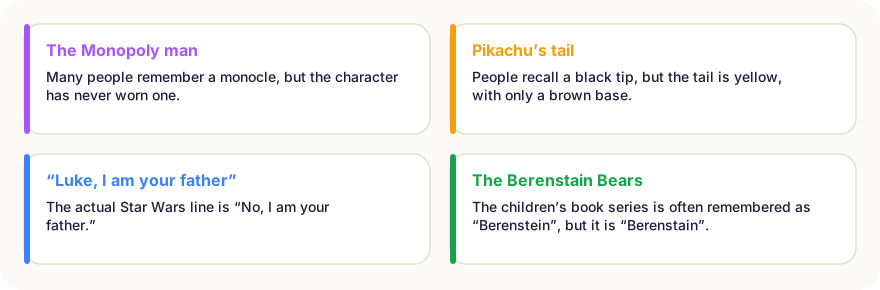
| What many people remember | What is actually true |
|---|---|
| The Monopoly man wears a monocle | He has never had a monocle |
| Pikachu’s tail has a black tip | The tail is yellow, with only a brown patch at the base |
| “Luke, I am your father” | “No, I am your father” |
| The Berenstein Bears | The Berenstain Bears |
| C-3PO from Star Wars is entirely gold | One of his lower legs is silver |
| “Mirror, mirror on the wall” in Disney’s Snow White | The queen says “Magic mirror on the wall” |
Memory is rebuilt, not replayed
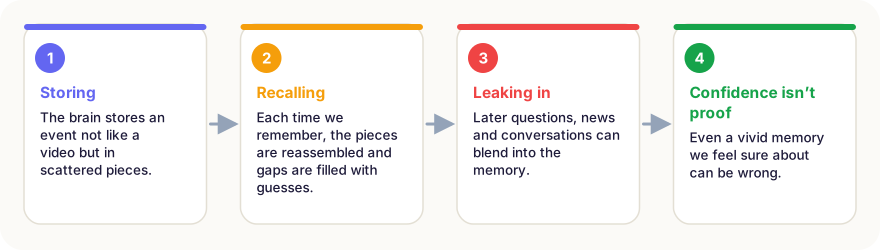
The key to the Mandela effect is a basic fact about human memory: it does not work like a video recording. When you experience something, your brain stores the gist and a selection of details. When you remember it later, you reconstruct the memory from those fragments, filling in the gaps with what seems most likely, based on your knowledge and expectations.
Most of the time this works well. It allows us to store vast amounts of information efficiently. But it means that memories can quietly change, and once a detail has been filled in, it feels exactly as real as the parts we actually saw.
Why do so many people make the same mistake?
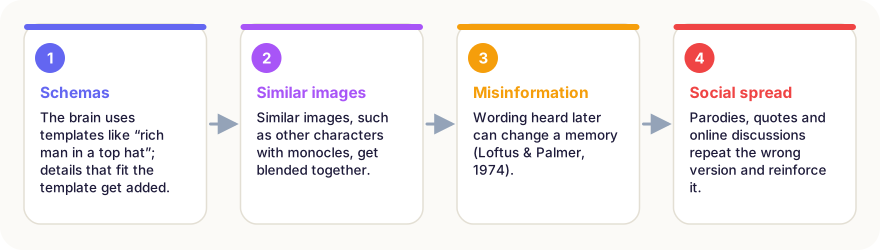
Shared false memories are not random. Psychologists point to several processes:
- Schemas: the brain uses mental templates. A wealthy, old-fashioned gentleman in a top hat “should” have a monocle, so the brain adds one. A cartoon animal’s tail “should” have a dark tip, like a fox.
- Similar images: other characters really do wear monocles, such as the peanut mascot of a well-known snack brand. Similar images blend in memory.
- Simplification: “Luke, I am your father” is a neater quote out of context, so people remember and repeat that version.
- Misinformation: in a classic 1974 experiment, Elizabeth Loftus and John Palmer showed people a film of a car crash. Those asked how fast the cars were going when they “smashed” into each other gave higher speed estimates than those asked about cars that “hit” each other, and in a follow-up experiment were more likely to falsely remember seeing broken glass. Information received after an event can reshape the memory of it.
- Social reinforcement: parodies, quotes, memes and conversations repeat the wrong version, making it ever more familiar.
What a 2022 study found
For years, the Mandela effect was mainly an internet phenomenon. In 2022, psychologists Deepasri Prasad and Wilma Bainbridge tested it in the lab and published the results in Psychological Science.
They showed participants correct and subtly altered versions of famous logos and characters and asked them to pick the right one, rate their confidence and say how familiar they were with each image. For several images, including the Monopoly man, Pikachu and C-3PO, many people chose the same wrong version, often with high confidence. Surprisingly, this happened even among people who said they had seen the images many times. When participants drew the images from memory, they often reproduced the same false details.
The researchers concluded that the visual Mandela effect is real and specific: certain images reliably trigger the same false memory across many people. Exactly why some images do this and others do not is still being studied.
No, it is not parallel universes
Online, some people suggest that the Mandela effect proves that we have slipped between parallel universes or that history has been changed. There is no scientific evidence for this. Ordinary memory processes, which can be observed and tested in the lab, explain the effect well. And when old copies of books, films and products are checked, they consistently show the “real” version.
Why it matters
The Mandela effect is a fun puzzle, but the science behind it has serious consequences. False memories can affect eyewitness testimony in court, where confident but mistaken witnesses have contributed to wrongful convictions. Elizabeth Loftus’s research helped change how police and courts treat memory evidence. The lesson is not that memory is useless, but that it is reconstructive, and that feeling certain is not the same as being right.
In short
- The Mandela effect means false memories shared by many people.
- The name comes from people wrongly remembering Nelson Mandela dying in prison; he died in 2013.
- Memory is reconstructed: the brain fills gaps with expectations and similar images.
- Schemas, misinformation and social repetition push many people toward the same mistake.
- A 2022 study found specific images trigger the same false memory across people, often with high confidence.
- It is not evidence of parallel universes, but a reminder that confidence ≠ accuracy.
Frequently asked questions
Where does the name ‘Mandela effect’ come from?
Around 2009 to 2010, blogger Fiona Broome discovered that many people shared her false memory of Nelson Mandela dying in prison in the 1980s. In fact, he was released in 1990, became South Africa’s president and died in 2013.
Is the Mandela effect proof of parallel universes?
No. Some online theories claim that false memories are evidence of alternate realities, but there is no scientific evidence for this. Well-understood features of human memory explain the effect.
Can you have a false memory and feel sure about it?
Yes. Studies show that confidence and accuracy are often poorly linked. A false memory can feel just as vivid and certain as a true one, which is why people defend Mandela effect memories so strongly.
How can I protect myself from false memories?
You cannot avoid them completely, since all memory is reconstructed. But checking original sources, writing important things down soon after they happen and being open to correction all help.
Sources
- Prasad & Bainbridge (2022) – The Visual Mandela Effect as Evidence for Shared and Specific False Memories Across People, Psychological Science
- Loftus & Palmer (1974) – Reconstruction of automobile destruction: An example of the interaction between language and memory, Journal of Verbal Learning and Verbal Behavior
This article is based on peer-reviewed research and publications from trusted institutions, and it is reviewed regularly. How we work →
You might also wonder
All in Brain & Mind →
Why Do We Have Phobias? How Intense Fears Form and How They Are Treated
Why are so many people terrified of spiders, heights or needles? How phobias form, which types are most common and why exposure therapy works so well.
Why Does Music Give You Chills? The Brain Science of Goosebumps from a Song
That shiver during a great song is frisson. How surprise, dopamine and the brain’s reward system turn music into goosebumps, and why not everyone feels it.

Why Do We Laugh? The Surprising Science of Laughter
Most laughter has nothing to do with jokes. Why we laugh far more with others, why laughter is contagious, how it relieves pain, and why apes laugh too.

Why Do We Procrastinate? It’s About Feelings, Not Laziness
Procrastination isn’t a time-management problem: it’s a way of escaping bad feelings. What science says about why we delay and the tricks that help.

Why Does Time Fly When You’re Having Fun? The Psychology of Time
An hour with friends vanishes while a boring meeting drags on. Why our sense of time stretches and shrinks, and why holidays seem long afterwards.

Can You Remember Things That Never Happened? How False Memories Form
Memory is not a video recording. Classic experiments show how a single word can change what people remember, and how vivid false memories can be created.