What Causes the Seasons? The Secret of Earth’s Tilted Axis
Are the seasons caused by Earth moving closer to the Sun? How the tilt of Earth’s axis creates summer and winter, explained step by step with diagrams.
Short answer
The seasons are caused by the tilt of Earth’s rotation axis, about 23.4 degrees. As Earth orbits the Sun, the Northern Hemisphere is tilted towards the Sun for part of the year and the Southern Hemisphere for the rest. The hemisphere tilted towards the Sun gets more direct sunlight and longer days, which brings summer. Earth’s distance from the Sun has almost nothing to do with it.
In this article (8)
Long sunny days in summer, short cold ones in winter — the cycle of the seasons is so familiar that most of us never question it. When asked, though, the most common answer is wrong: “Earth is closer to the Sun in summer.” The real reason is far more interesting, and it comes down to our planet leaning slightly to one side.
The common misconception: distance
Earth’s orbit around the Sun is not a perfect circle but a slightly flattened ellipse, so our distance from the Sun changes a little over the year:
| Point | Date | Distance from the Sun |
|---|---|---|
| Perihelion (closest) | Early January | ~147.1 million km |
| Aphelion (farthest) | Early July | ~152.1 million km |
Notice that Earth is closest to the Sun in January, during the northern winter. If distance controlled the seasons, January would be summer. And the difference between the two extremes is only about 3%, which has only a small effect on temperature.
There is another giveaway: if distance were the cause, both hemispheres would have summer at the same time. Yet when it is summer in Europe and North America, it is winter in Australia, Argentina and South Africa.
The real cause: a 23.4-degree tilt
As Earth spins, its axis is not perpendicular to the plane of its orbit. It is tilted by about 23.4 degrees. Even more importantly, the axis keeps pointing in the same direction in space: its northern end points roughly towards the North Star all year round.
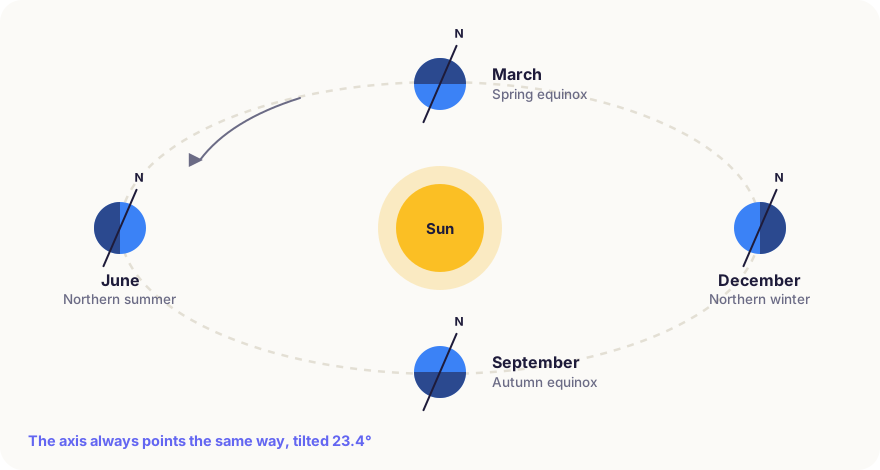
Put those two facts together and you get this picture:
- Around June, the Northern Hemisphere is tilted towards the Sun: summer in the north, winter in the south.
- Around December, Earth is on the other side of its orbit. The axis still points the same way, so now the Southern Hemisphere faces the Sun: winter in the north, summer in the south.
- In March and September, both hemispheres face the Sun equally. These are the equinoxes, when day and night are roughly equal everywhere.
How does the tilt change temperature?
The tilt warms or cools a hemisphere in two different ways.
1. The angle of sunlight
When the Sun is high in the sky, its rays strike the ground steeply and the energy is concentrated on a small area. When the Sun is low, the same beam hits the ground at a shallow angle and spreads over a much larger area, so each square metre receives less energy.
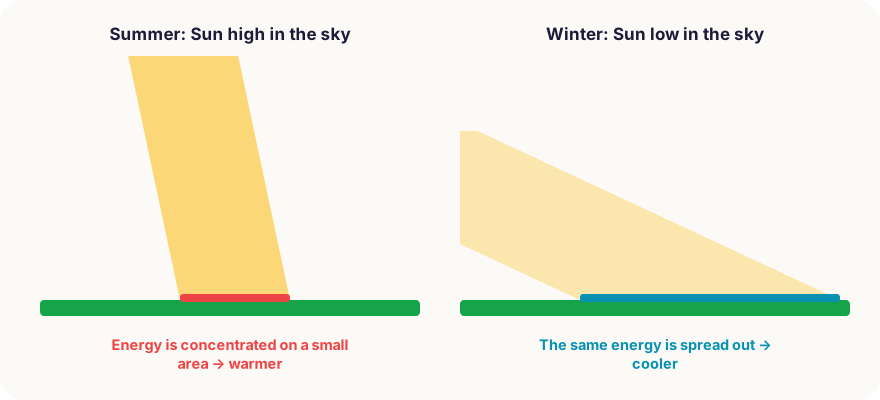
You can try this with a torch. Point it straight down at a table and you get a small, bright circle. Tilt it and the light stretches into a long, faint oval. That is why the winter Sun feels so weak.
Low-angle sunlight also travels through more atmosphere, where more of it is scattered and absorbed, so even less energy reaches the ground.
2. Day length
In the hemisphere tilted towards the Sun, the Sun traces a longer arc across the sky and days get longer. Longer days give the ground and air more time to warm up, and shorter nights leave less time for that heat to escape.
The effect grows towards the poles:
- In London the longest day lasts about 16.5 hours and the shortest about 8 hours.
- North of the Arctic Circle the Sun does not set for days in summer (the midnight sun) and does not rise for days in winter (the polar night).
- At the equator day length stays very close to 12 hours all year.
Solstices and equinoxes
Four key moments mark the year. Their exact dates can shift by a day because of how calendars work:
| Event | Approximate date | What happens in the Northern Hemisphere? |
|---|---|---|
| March equinox | 20 March | Day and night roughly equal |
| June solstice | 20–21 June | Longest day of the year |
| September equinox | 22–23 September | Day and night roughly equal |
| December solstice | 21–22 December | Shortest day of the year |
Astronomers count the seasons as starting at these moments (astronomical seasons). Meteorologists, for convenience in keeping statistics, divide the year into whole months: in the Northern Hemisphere, summer is June, July and August (meteorological seasons).
Why are the hottest days in July and August?
If we receive the most solar energy in late June, why do the hottest days come weeks later? The answer is seasonal lag.
Oceans, lakes and soil absorb heat slowly and release it slowly. Even after the days start shortening in late June, the energy coming in still exceeds the energy going out for a while, so temperatures peak in July and August. For the same reason, the coldest weather usually arrives in January and February rather than December.
The lag is stronger in coastal cities, because water warms and cools much more slowly than land.
What if Earth had no tilt?
If Earth’s axis stood perfectly upright:
- Every day, everywhere, day and night would each last about 12 hours.
- The climate where you live would barely change through the year. The equator would always be hot and the poles always cold.
- Seasonal cycles such as spring blossom, autumn leaf fall and bird migration would not look the way they do today.
Scientists think Earth’s tilt stays fairly stable thanks to the gravity of the Moon. Even so, it varies slightly between about 22.1 and 24.5 degrees over a cycle of roughly 41,000 years — small changes known to play a role in the timing of ice ages.
Seasons on other planets
Seasons are not unique to Earth. Each planet has its own tilt:
- Mars: tilted about 25 degrees. Because its year lasts nearly two Earth years, its seasons are roughly twice as long.
- Jupiter: tilted only about 3 degrees, so it has no noticeable seasons.
- Uranus: tilted about 98 degrees — it essentially rolls around the Sun on its side. Each pole gets about 42 years of continuous daylight followed by 42 years of darkness.
In short
The seasons are caused not by our distance from the Sun but by Earth’s 23.4-degree axial tilt. The hemisphere leaning towards the Sun receives more direct sunlight and longer days, bringing summer, while the other receives slanting light and short days, bringing winter. Next time the June solstice comes round, picture Earth gliding through space, leaning gently to one side.
Frequently asked questions
Is Earth closer to the Sun in summer?
No. Earth reaches its closest point to the Sun (perihelion) in early January and its farthest (aphelion) in early July. The difference is only about 3% and does not drive the seasons.
Why are the seasons reversed in the two hemispheres?
Because of the tilt, when the Northern Hemisphere leans towards the Sun the Southern Hemisphere leans away. That is why it is winter in Australia when it is summer in Europe.
When is the longest day?
In the Northern Hemisphere the longest day is the June solstice on 20 or 21 June, and the shortest is the December solstice on 21 or 22 December.
Are there seasons at the equator?
At the equator the Sun stays high all year and day length barely changes, so there are no distinct warm and cold seasons. Many equatorial regions have wet and dry seasons instead.
Why are the hottest days in July and August, not at the solstice?
Oceans and land store heat slowly. Even after June, incoming energy still exceeds what is lost, so temperatures keep rising for several weeks. This is called seasonal lag.
Sources
This article is based on peer-reviewed research and publications from trusted institutions, and it is reviewed regularly. How we work →
You might also wonder
All in Space →
What Are Shooting Stars? Meteors, Meteor Showers and Where to See Them
Shooting stars are not stars at all. What makes those streaks of light, why do meteor showers happen on the same dates every year, and how can you see the most?
Why Does Saturn Have Rings? What They Are Made Of and How Old They Are
Saturn’s rings are made of billions of ice chunks, yet they are only metres thick. Where did they come from, why aren’t they a moon, and will they vanish?
Why Does the Moon Look Bigger on the Horizon? The Moon Illusion Explained
A rising full Moon looks huge, yet it is no bigger than when it is high in the sky. Why does our brain inflate it, and how can you prove the illusion yourself?
How Do Solar Eclipses Work? Why the Moon Fits the Sun Perfectly
A total solar eclipse happens when the Moon exactly covers the Sun. Why the fit is so perfect, the types of eclipse, and how to watch one safely.
Why Do We Only See One Side of the Moon? Tidal Locking Explained
The Moon spins once for every trip around Earth, so the same face always points at us. How tidal locking works, and why the far side is not really dark.
Why Is Pluto Not a Planet? The 2006 Decision Explained
Pluto lost its planet status in 2006. The three rules astronomers set for a planet, why Pluto fails one, and what New Horizons revealed about this icy world.