How Old Is the Earth? 4.54 Billion Years and How Scientists Worked It Out
Earth is about 4.54 billion years old. How radioactive ‘clocks’ in rocks, meteorites and zircon crystals revealed its age, and what happened in all that time.

Short answer
The Earth is about 4.54 billion years old, with an uncertainty of less than 1 percent, according to the US Geological Survey. Scientists cannot date it directly from Earth’s first rocks, because plate tectonics and erosion have recycled them. Instead, they use radiometric dating: radioactive elements such as uranium decay into lead at a known, steady rate, so the ratio of the two in a mineral works like a clock. Meteorites, leftovers from the birth of the solar system, give ages of 4.53 to 4.58 billion years. The oldest Earth materials found so far are tiny zircon crystals from Western Australia, about 4.4 billion years old, and the oldest known rocks are about 4.03 billion years old.
In this article (8)
How long has the Earth been here? For most of human history, people could only guess. Some estimates, based on ancient texts, put the age at a few thousand years. Nineteenth-century scientists, using the cooling of the planet or the saltiness of the sea, came up with tens or hundreds of millions of years. The real answer turned out to be far larger: about 4.54 billion years. Finding it required one of the great discoveries of physics, radioactivity.
The short answer: 4.54 billion years
According to the US Geological Survey (USGS), the best age for the Earth is 4.54 billion years, with an uncertainty of less than 1 percent. That is about a third of the age of the universe, which is roughly 13.8 billion years old.
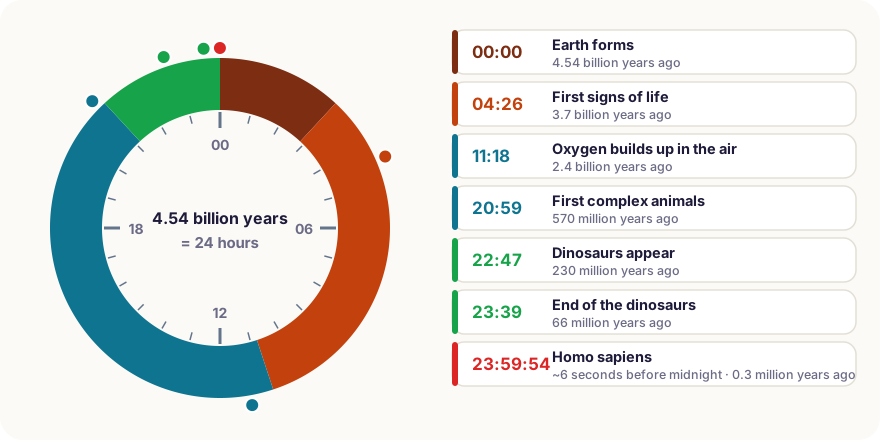
Numbers this large are hard to imagine. One way to grasp them is to squeeze Earth’s whole history into a single day. On that clock, the first signs of life appear in the early morning, oxygen builds up in the air around lunchtime, the first complex animals arrive in the evening, dinosaurs rule from about 10:47 pm to 11:39 pm, and Homo sapiens appears only about six seconds before midnight.
Why can’t we just date the oldest rock?
It might seem simple: find the oldest rock on Earth and measure its age. The problem, as the USGS explains, is that Earth is an active planet. Plate tectonics keeps recycling the crust, pushing old rocks deep into the mantle and melting them, while erosion wears down whatever reaches the surface. Earth’s original crust has been destroyed.
The oldest rocks found so far are the Acasta Gneiss in northwestern Canada, about 4.03 billion years old. Even these are not the first crust: they formed from earlier material.
Clues in tiny crystals
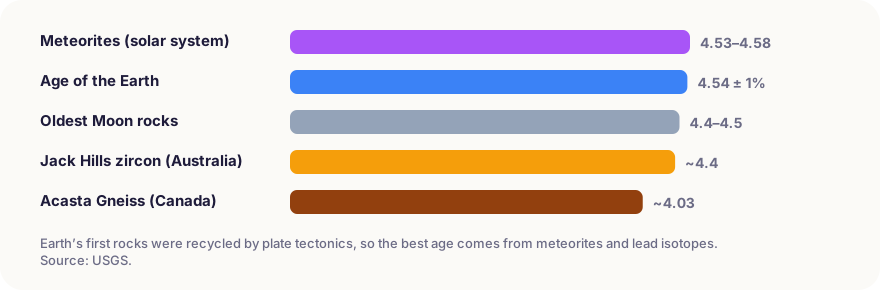
Some of Earth’s oldest witnesses are grains of a mineral called zircon, each smaller than a grain of sand. Zircon is extremely tough and can survive when the rock around it erodes away. In the Jack Hills of Western Australia, geologists found zircon grains in younger sedimentary rocks.
In 2001, Simon Wilde and colleagues reported in Nature that one of these crystals was about 4.4 billion years old. Chemical clues in the crystal suggested that it formed in the presence of liquid water, which hints that Earth may have had continental crust and oceans surprisingly early in its history.
Radiometric dating: clocks inside rocks
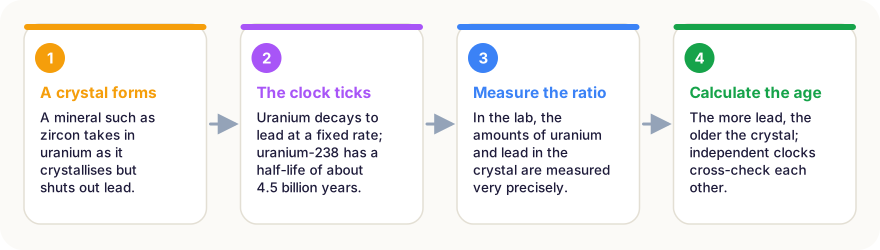
The key to dating rocks is radioactive decay. Some elements are unstable: their atoms slowly change into other elements. Each radioactive isotope does this at a fixed rate, described by its half-life, the time it takes for half of the atoms to decay.
- Uranium-238 decays into lead-206 with a half-life of about 4.5 billion years.
- Uranium-235 decays into lead-207 with a half-life of about 700 million years.
When a zircon crystal forms, it takes in uranium but almost no lead. From that moment, lead slowly builds up inside. By measuring the ratio of uranium to lead, scientists can calculate how long ago the crystal formed. Because there are two uranium “clocks” in the same crystal, they can check each result against the other.
Meteorites: leftovers from the beginning
If Earth’s first rocks are gone, how do we get to 4.54 billion years? The answer comes from space. Meteorites are fragments of asteroids that formed at the same time as the planets and have barely changed since. According to the USGS, more than 70 meteorites have been dated, giving ages between 4.53 and 4.58 billion years.
The most precise age comes from lead isotopes. Lead in Earth’s oldest ores and in meteorites has evolved from the same starting mixture. In the 1950s, the American geochemist Clair Patterson compared lead from an iron meteorite with lead from Earth and calculated an age of about 4.55 billion years, very close to today’s value. While doing this work, Patterson noticed how much lead from petrol was contaminating his samples, and he went on to campaign successfully to remove lead from petrol.
| Material | Approximate age | Where |
|---|---|---|
| Meteorites | 4.53–4.58 billion years | Fragments of asteroids |
| Earth (best estimate) | 4.54 billion years | From lead isotopes |
| Oldest Moon rocks | 4.4–4.5 billion years | Returned by Apollo and Luna missions |
| Oldest zircon crystals | ~4.4 billion years | Jack Hills, Western Australia |
| Oldest rocks | ~4.03 billion years | Acasta Gneiss, Canada |
| Ancient rocks of Greenland | 3.7–3.8 billion years | Isua, West Greenland |
A brief history of a very long time
Once we know the age, we can place major events on Earth’s timeline. Geologists divide it into four great eons:
- Hadean (4.54 to about 4.0 billion years ago): a hot, violent young planet, often bombarded by asteroids. The Moon formed early in this time.
- Archean (4.0 to 2.5 billion years ago): the first continents and the earliest evidence of life, simple microbes.
- Proterozoic (2.5 billion to 539 million years ago): oxygen builds up in the atmosphere, and the first complex cells and multicellular life appear.
- Phanerozoic (539 million years ago to today): the explosion of animal life, plants on land, dinosaurs, mammals and finally humans.
Why the age matters
The age of the Earth is not just a number. It gave evolution the vast stretches of time it needs, explained how mountains can rise and wear away, and showed that our planet, our Moon and the meteorites all formed together with the Sun. Few measurements have changed our view of our place in the universe more.
In short
- Earth is about 4.54 billion years old, with less than 1% uncertainty.
- Its first rocks were recycled by plate tectonics and erosion, so we cannot date them directly.
- Radiometric dating uses steady radioactive decay, such as uranium to lead, as a clock.
- Meteorites formed with the solar system and give ages of 4.53–4.58 billion years.
- The oldest Earth crystals are zircons of about 4.4 billion years; the oldest rocks about 4.03 billion.
- On a 24-hour clock, humans appear about six seconds before midnight.
Frequently asked questions
How do we know the Earth is 4.54 billion years old?
By measuring how much uranium has decayed into lead in meteorites and in Earth’s oldest lead ores. Several independent radioactive ‘clocks’ give consistent results, which gives scientists confidence in the age.
What is the oldest rock on Earth?
The Acasta Gneiss in northwestern Canada, about 4.03 billion years old, is among the oldest known rocks. Individual zircon crystals in Western Australia are even older, at about 4.4 billion years.
Is the Earth older than the Moon?
Slightly. The leading theory says the Moon formed from debris after a Mars-sized body struck the young Earth, so the Moon is a little younger. The oldest Moon rocks are about 4.4 to 4.5 billion years old.
How old is the universe compared with Earth?
The universe is about 13.8 billion years old, roughly three times older than Earth. The Sun and its planets formed about 9 billion years after the Big Bang.
Sources
- US Geological Survey – Age of the Earth
- Wilde et al. (2001) – Evidence from detrital zircons for the existence of continental crust and oceans on the Earth 4.4 Gyr ago, Nature
This article is based on peer-reviewed research and publications from trusted institutions, and it is reviewed regularly. How we work →
You might also wonder
All in Earth & Nature →
How Are Mountains Formed? Colliding Plates, Volcanoes and the Rise of the Himalayas
Most mountains are built by colliding plates. How fold, volcanic and fault-block mountains form, why Everest still grows and how erosion wears them down.

How Do Hurricanes Form? From Warm Ocean to Monster Storm
Hurricanes are giant storms powered by warm ocean water. How they form, why they spin, what the categories mean and how climate change affects them.

How Do Snowflakes Form? Why They Have Six Sides and Are All Different
Every snowflake grows from a speck of dust in a cloud. Why snow crystals have six sides, how temperature shapes them, and whether no two are really alike.

What Causes Wind? Pressure, Sunshine and a Spinning Earth
Wind is air moving from high to low pressure, driven by the Sun heating Earth unevenly. How sea breezes, trade winds and the jet stream form, explained simply.
How Do Tornadoes Form? From Spinning Air to a Funnel Cloud
Most strong tornadoes grow out of supercell thunderstorms, where wind shear and rising air create a rotating column. How they form and how they are rated.

How Do Tsunamis Form? Why a Small Ripple at Sea Becomes a Wall of Water
Most tsunamis start when an undersea earthquake suddenly lifts the seafloor. How they cross oceans at jet speed, grow at the coast, and how to stay safe.