What Causes Earthquakes? Faults, Magnitude and Seismic Waves Explained
How do earthquakes happen, what does magnitude really mean and can quakes be predicted? Plates, faults, seismic waves and what to do when the ground shakes.
Short answer
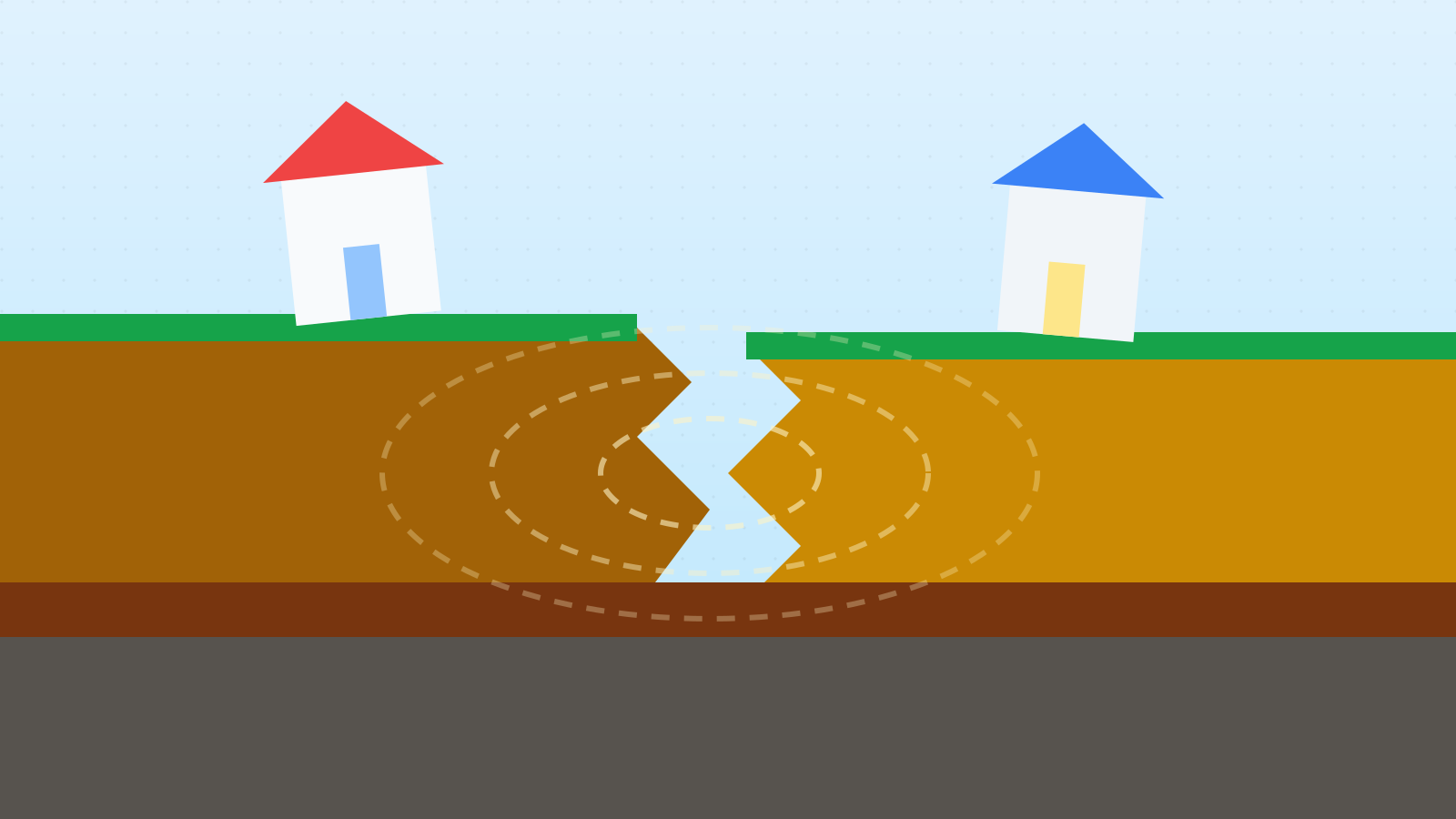
Earth’s crust is made of huge plates that move very slowly relative to each other. Along faults at their edges, rocks lock together through friction and build up strain for years. When the strain exceeds the strength of the rock, it suddenly slips within seconds. The energy released spreads out as seismic waves that shake the ground.
In this article (8)
An earthquake can strike without warning, turning solid ground into something that rolls and lurches beneath your feet. Some of the deadliest natural disasters in history — from Lisbon in 1755 to Japan in 2011 and Turkey and Syria in 2023 — were caused by earthquakes. Understanding them is the first step towards living with them.
Earth is a jigsaw puzzle
Earth’s outer layer, the lithosphere, is not one solid shell. It is broken into giant pieces called tectonic plates, between 15 and 200 kilometres thick. These plates move a few centimetres a year over the hot, slowly flowing layer beneath them — roughly the speed at which your fingernails grow.
Plates interact at their edges in three ways:
| Boundary type | What happens | Example |
|---|---|---|
| Divergent | Plates move apart | The Mid-Atlantic Ridge |
| Convergent | Plates collide; one may dive beneath the other | Japan, the Himalayas |
| Transform | Plates slide past each other | San Andreas Fault, North Anatolian Fault |
How does an earthquake happen?
Plates do not glide smoothly. Along faults — fractures in the crust — the rocks catch on each other and lock together through friction. Because the plates keep moving, strain builds up in these locked zones. The rocks slowly bend, like a ruler being flexed.
Eventually the strain exceeds the strength of the rock and the fault suddenly slips within seconds. Geologists call this elastic rebound: the bent rocks spring back, releasing energy that may have built up over decades or centuries in an instant.
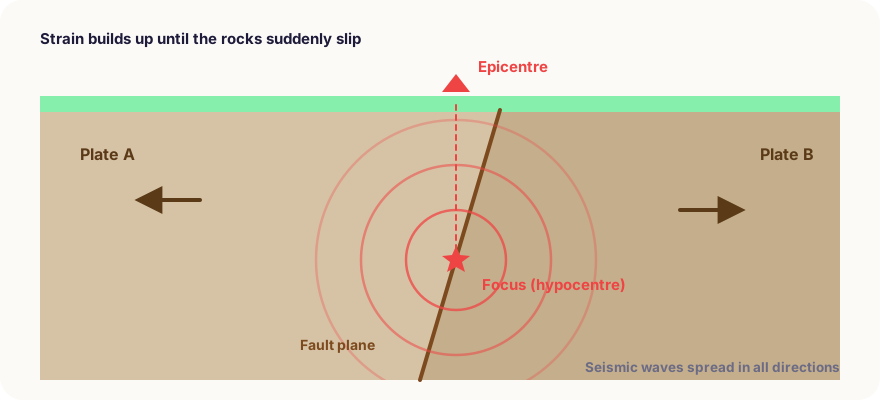
- Focus (hypocentre): the point underground where the slip begins. Most earthquakes start at depths of 0–70 kilometres.
- Epicentre: the point on the surface directly above the focus — the location reported in the news.
In large earthquakes the fault does not just break at one point but tears along tens or even hundreds of kilometres. In the 2023 Kahramanmaraş earthquake in Turkey, the fault ruptured along more than 300 kilometres.
Seismic waves: how the shaking spreads
The energy released travels through and around the Earth as waves. There are three main types:
- P waves (primary): the fastest, travelling at about 6 kilometres per second in the crust. They push and pull the rock back and forth. The first rumble and light jolt of a quake are often P waves.
- S waves (secondary): arrive at about 3.5 kilometres per second, shaking the ground up and down and side to side, and are stronger.
- Surface waves: the slowest but usually the most destructive, travelling along the surface. They cause most of the damage to buildings.
The time gap between P and S waves lets seismologists work out how far away a quake is. Earthquake early-warning systems exploit this gap: when stations near the epicentre detect the fast P waves, alerts can be sent to distant cities seconds to tens of seconds before the damaging waves arrive.
What does magnitude mean?
The number that describes the energy released at the source is the magnitude. Today scientists mostly use the moment magnitude (Mw) scale. Its key feature is that it is logarithmic:
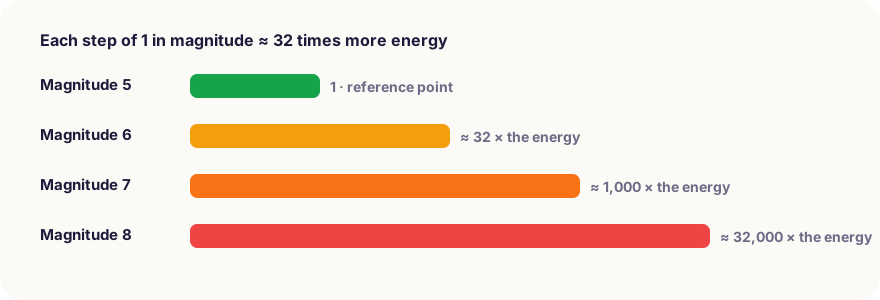
- Each 1-point increase in magnitude means about 32 times more energy.
- A 2-point increase means about 1,000 times more energy.
So a magnitude 7.8 earthquake is not just “a bit stronger” than a 5.8 — it releases roughly a thousand times more energy. The largest earthquake ever recorded, in Chile in 1960, reached magnitude 9.5.
Magnitude and intensity are different. Magnitude is a single number for the source; intensity describes how shaking is felt and how much damage it does at a given location. Intensity depends on distance from the epicentre, the type of ground and how well buildings are built. Soft, waterlogged sediments amplify shaking, while solid bedrock shakes less.
Where do earthquakes happen?
Most earthquakes occur along plate boundaries. Roughly 80–90% of them happen around the Pacific Ocean in the so-called Ring of Fire, which stretches from New Zealand through Japan and Alaska down to Chile. Another major belt runs from the Mediterranean through Turkey and Iran to the Himalayas, where the African, Arabian and Indian plates push into Eurasia.
Earthquakes can also happen far from plate boundaries, where old faults inside a plate are reactivated. These intraplate quakes are rarer but can be surprisingly strong.
Can earthquakes be predicted?
With today’s scientific knowledge, it is not possible to predict the time, place and size of an earthquake. What scientists can do is:
- study past earthquakes and how fast faults slip to identify where large quakes are likely;
- produce seismic hazard maps that guide building codes;
- issue early warnings once a quake has already begun.
Claims on social media that “an earthquake will hit on this date” have no scientific basis.
What to do before and during an earthquake
We cannot stop earthquakes, but we can greatly reduce their impact. The most important step is living and working in earthquake-resistant buildings. In addition:
Before an earthquake:
- Secure heavy furniture such as wardrobes, bookcases and fridges to the wall.
- Prepare an emergency kit with water, food, a torch, a whistle, first-aid supplies and copies of important documents.
- Agree on a meeting point with your family.
During an earthquake:
- Drop, cover and hold on: get down, take cover under a sturdy table protecting your head and neck, and hold on.
- Stay away from windows, glass cabinets and anything that could fall.
- Do not run for stairs or lifts while the shaking continues.
- If you are outside, move to an open area away from buildings, trees and power lines.
After an earthquake:
- If you smell gas, do not touch light switches or light flames, and shut off the supply.
- Do not enter damaged buildings, and be prepared for aftershocks.
In short
Earthquakes are the sudden release of strain that builds up for years along faults at plate boundaries, when the rocks finally slip. The energy spreads out as seismic waves that shake the ground. The magnitude scale is logarithmic, so small numerical differences mean huge differences in energy. We cannot predict earthquakes — but with sound buildings and good preparation we can dramatically reduce the harm they cause.
Frequently asked questions
Can earthquakes be predicted?
No. Scientists can identify regions where large earthquakes are likely, but there is no method to forecast the exact time, place and size of a quake. Earthquake early-warning systems can only send alerts once a quake has begun, seconds before the strongest shaking arrives.
Are magnitude and intensity the same thing?
No. Magnitude measures the energy released at the source and is a single number. Intensity describes how strongly shaking is felt and how much damage it causes at a particular place. The same quake can be violent near the epicentre and mild far away.
What should I do during an earthquake?
Drop, cover and hold on: drop to the ground, take cover under a sturdy table protecting your head and neck, and hold on until the shaking stops. Do not run for stairs, lifts or windows while the ground is shaking.
Why do aftershocks happen?
After a large quake, the rocks around the fault settle into a new balance, causing smaller slips. Aftershocks can continue for weeks or months, becoming less frequent over time.
Sources
This article is based on peer-reviewed research and publications from trusted institutions, and it is reviewed regularly. How we work →
You might also wonder
All in Earth & Nature →
How Do Snowflakes Form? Why They Have Six Sides and Are All Different
Every snowflake grows from a speck of dust in a cloud. Why snow crystals have six sides, how temperature shapes them, and whether no two are really alike.
What Causes Wind? Pressure, Sunshine and a Spinning Earth
Wind is air moving from high to low pressure, driven by the Sun heating Earth unevenly. How sea breezes, trade winds and the jet stream form, explained simply.
How Do Tornadoes Form? From Spinning Air to a Funnel Cloud
Most strong tornadoes grow out of supercell thunderstorms, where wind shear and rising air create a rotating column. How they form and how they are rated.
How Do Tsunamis Form? Why a Small Ripple at Sea Becomes a Wall of Water
Most tsunamis start when an undersea earthquake suddenly lifts the seafloor. How they cross oceans at jet speed, grow at the coast, and how to stay safe.

What Causes the Northern Lights? How the Aurora Gets Its Colours
The aurora is created when particles from the Sun hit gases high in our atmosphere. Why it glows green, red and purple, and where and when to see it.
Why Do Leaves Change Colour in Autumn? The Science of Yellow, Orange and Red
Why do leaves turn yellow or red in autumn, and why do trees drop them? The pigments in leaves, colourful autumns and why America is redder than Europe.