Do Trees Communicate? The ‘Wood Wide Web’, Chemical Warnings and What Science Really Says
Trees are linked by underground fungi and can warn neighbours with airborne chemicals. What is proven about tree ‘communication’ and which claims go too far.
Short answer
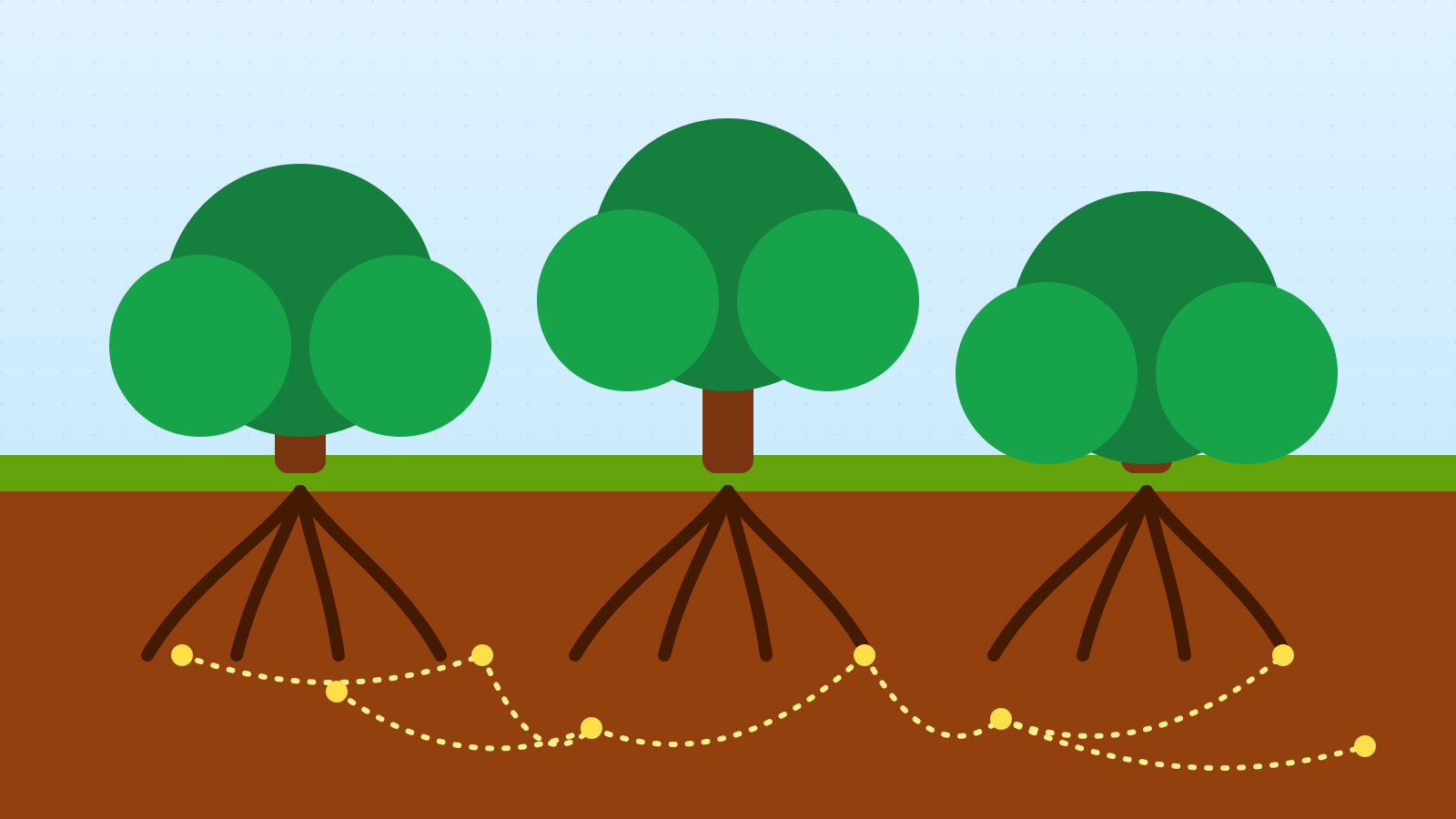
Trees do exchange signals and substances, but not in the way people talk. Above ground, many plants release airborne chemicals when insects attack them, and neighbouring plants can detect these and strengthen their own defences, an effect first reported in trees in 1983. Below ground, most trees live in partnership with mycorrhizal fungi, whose fine threads wrap around roots, trading water and nutrients for sugars. These fungal threads can connect several trees, and some experiments have shown carbon moving between trees through them, giving rise to the idea of a ‘wood wide web’. However, a 2023 review found that popular claims, such as ‘mother trees’ feeding their seedlings through these networks, go well beyond the evidence.
In this article (8)
A forest looks peaceful and still. But in recent years, books, documentaries and viral videos have described it as a bustling social network: trees “talking” through underground fungi, mother trees feeding their offspring, sick trees warning their neighbours. Some of this is solid science. Some of it is an exciting idea that has run ahead of the evidence. Here is how to tell the difference.
Two kinds of “communication”
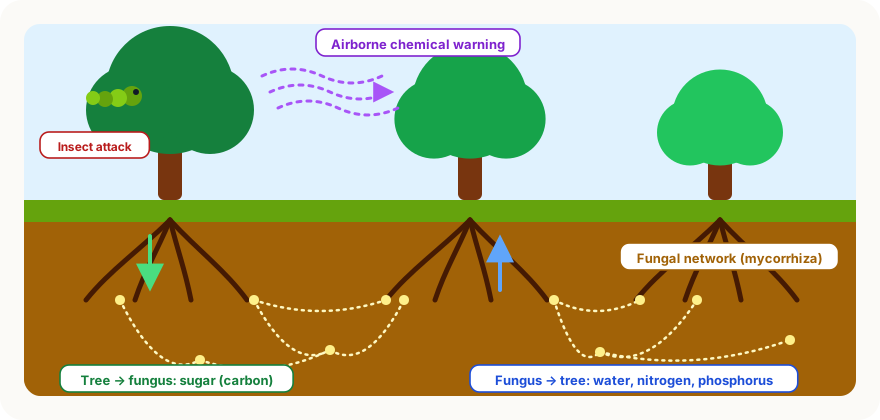
When scientists talk about plants communicating, they mean something specific: one plant releasing a signal or substance that another plant detects and responds to. There is no language, no intention and no brain involved. Trees can exchange information and resources in two main ways:
- through the air, using volatile chemicals,
- through the soil, using networks of fungi connected to their roots.
Warnings on the wind
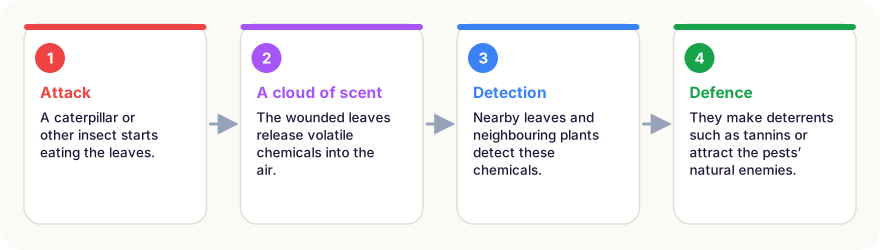
In 1983, Ian Baldwin and Jack Schultz reported a surprising result in Science. They damaged the leaves of young poplar and sugar maple trees and found that undamaged trees nearby also increased their levels of defensive chemicals, such as tannins, which make leaves harder to digest for insects. The undamaged trees were not connected to the damaged ones, so the signal seemed to travel through the air. The press quickly called them “talking trees”.
Since then, this kind of airborne signalling has been studied in many plants. When an insect chews a leaf, the plant releases a blend of volatile organic compounds, the same kind of molecules that give cut grass its smell. Neighbouring plants, and even other branches of the same plant, can detect these chemicals and switch on their defences in advance. Some of these scents also attract the natural enemies of the pests, such as parasitic wasps, a bit like a call for help.
Scientists still debate whether this is truly “communication” or simply neighbours “eavesdropping” on chemicals that the damaged plant releases for its own reasons. Either way, the effect itself is well documented.
The partnership underground
Below ground, the story begins with one of the most important partnerships in nature. Most land plants, including most trees, live together with mycorrhizal fungi (from the Greek for “fungus” and “root”). Their extremely fine threads, called hyphae, wrap around or grow into the roots and spread far into the soil.
The deal works like this:
- The tree gives the fungus sugars, made by photosynthesis.
- The fungus gives the tree water and nutrients, such as nitrogen and phosphorus, which its fine threads can reach far better than roots.
This partnership is ancient, dating back to the first land plants more than 400 million years ago, and it is essential for the health of most forests.
The “wood wide web”
Because one fungus can connect to several trees, and one tree can host many fungi, the roots of a forest can be linked by common mycorrhizal networks. In 1997, forest ecologist Suzanne Simard and colleagues published a study in Nature using carbon isotopes as tracers. They found that carbon moved between paper birch and Douglas fir seedlings in the field, apparently through the fungal connections, and that shaded fir seedlings received more. The journal’s cover story called it the “wood-wide web”.
That study inspired a wave of research and later popular books describing forests as cooperative communities, with large “mother trees” feeding their young through the network and sending warnings to their neighbours.
What the evidence really shows
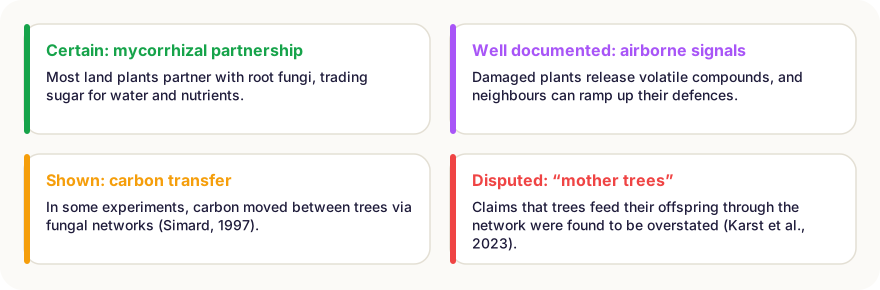
In 2023, Justine Karst and colleagues published a careful review in Nature Ecology & Evolution. They examined the field studies behind three popular claims and found that:
| Claim | What the review found |
|---|---|
| Fungal networks are widespread in forests | Plausible, but very hard to map in real forests; few studies have actually traced the connections |
| Resources move through the networks and help seedlings | Results are mixed; when transfer occurs, it is often small, and other routes, such as through soil, are hard to rule out |
| Mature trees preferentially help their offspring | No peer-reviewed field study has shown this convincingly |
The authors also found a citation bias: papers with positive, exciting conclusions were cited far more often than cautious ones, and some popular accounts overstated what the original studies showed. Their conclusion was not that fungal networks are a myth, but that much more evidence is needed before saying that trees “share” resources or “nurture” their young through them.
It is also worth remembering that fungi are living organisms with their own interests. A network that moves nutrients may serve the fungus as much as the trees.
Why it matters
The question is not just academic. Ideas about cooperative forests have influenced forestry policies, such as whether to leave large old trees standing when an area is logged. Scientists stress that such decisions should be based on solid evidence, and there are many good reasons to protect old trees, from biodiversity to carbon storage, whatever the truth about fungal networks.
So, do trees communicate?
In a limited, chemical sense, yes. Plants release signals, and their neighbours respond. Trees are also deeply connected to fungi that move water and nutrients through the soil. But the image of trees chatting, caring for their children or making decisions is a metaphor. Real forests are fascinating enough without it: complex systems of plants, fungi, microbes and animals that compete, cooperate and influence each other in ways scientists are still uncovering.
In short
- Plants can release airborne chemicals when attacked, and neighbours can boost their defences.
- Most trees partner with mycorrhizal fungi: sugar for the fungus, water and nutrients for the tree.
- Fungal threads can link several trees in common mycorrhizal networks, the “wood wide web”.
- A 1997 study showed carbon moving between trees via fungal connections.
- A 2023 review found claims about “mother trees” feeding their young are not supported by field evidence.
- Trees have no brain; their “communication” is chemical, not conscious.
Frequently asked questions
What is the ‘wood wide web’?
It is a popular name for common mycorrhizal networks: underground webs of fungal threads that can connect the roots of several plants and through which water, nutrients and carbon may move.
Do trees help each other?
Some studies suggest that resources can move between trees via fungi, but how often this happens in natural forests, and whether it really benefits the receiving tree, is still debated. Fungi also act in their own interest.
Can plants warn each other of danger?
Yes, this is well documented. Damaged plants release volatile compounds, and neighbouring plants that detect them often increase their defences, for example by producing more bitter or toxic chemicals.
Do trees feel pain or think?
There is no evidence that trees feel pain or think. They have no brain or nerves. Their responses to damage or signals are chemical and electrical processes, not conscious experiences.
Sources
- Simard et al. (1997) – Net transfer of carbon between ectomycorrhizal tree species in the field, Nature
- Karst et al. (2023) – Positive citation bias and overinterpreted results lead to misinformation on common mycorrhizal networks in forests, Nature Ecology & Evolution
- Baldwin & Schultz (1983) – Rapid changes in tree leaf chemistry induced by damage: evidence for communication between plants, Science
This article is based on peer-reviewed research and publications from trusted institutions, and it is reviewed regularly. How we work →
You might also wonder
All in Plants →
What Is the Biggest Tree in the World? General Sherman, Hyperion and Other Giants
The biggest tree is the giant sequoia General Sherman; the tallest is the redwood Hyperion. Meet the record trees and learn why trees cannot grow forever.
Why Do Flowers Smell? The Chemistry and Purpose of Floral Scents
Flower scents are chemical messages. Why flowers smell, how petals make fragrance from sugar, why some stink of rotting meat and why roses lost their scent.

Do Sunflowers Follow the Sun? Yes, But Only When They Are Young
Young sunflowers turn east to west each day and swing back at night. Mature ones stop and face east. How the plant’s inner clock and bees explain it.
How Do Plants Drink Water? How Trees Lift Water 100 Metres Without a Pump
Plants have no heart, yet the tallest trees lift water over 100 metres. How roots, xylem and evaporation from leaves pull water up from the soil.
Why Are Leaves Green? Chlorophyll, Photosynthesis and a Puzzle
Leaves are green because chlorophyll absorbs red and blue light. But why would plants waste the most abundant colour of sunlight? The surprising answer.
Are Mushrooms Plants? Why Fungi Are Closer to Animals
Mushrooms grow in soil and don’t move, but they are not plants. Why fungi form their own kingdom, how they feed and why they are closer to animals.